Golden Threshold

The wind of change forever blows
Across the tumult of our way,
To-morrow’s unborn griefs depose
The sorrows of our yesterday.
Dream yields to dream, strife follows strife,
And Death unweaves the webs of Life.


The fragment of the poem quoted above is, as you might have guessed, from Golden Threshold, the book of Sarojini Naidu’s poems that was first published in 1905 (and which still seems to be in print, from Dodo Press).

Sarojini Naidu has, through her legacy played a large role in the creation of our University, most famously by the donation of Golden Threshold, the iconic building in the centre of Hyderabad where the University took seed. I recall coming to the University in the early 1980’s and setting off for the Gachibowli campus from there. At the time, the building itself seemed nice but unremarkable, and since I was there so briefly it made no particular impression on me. Since coming back, its been quite another story…

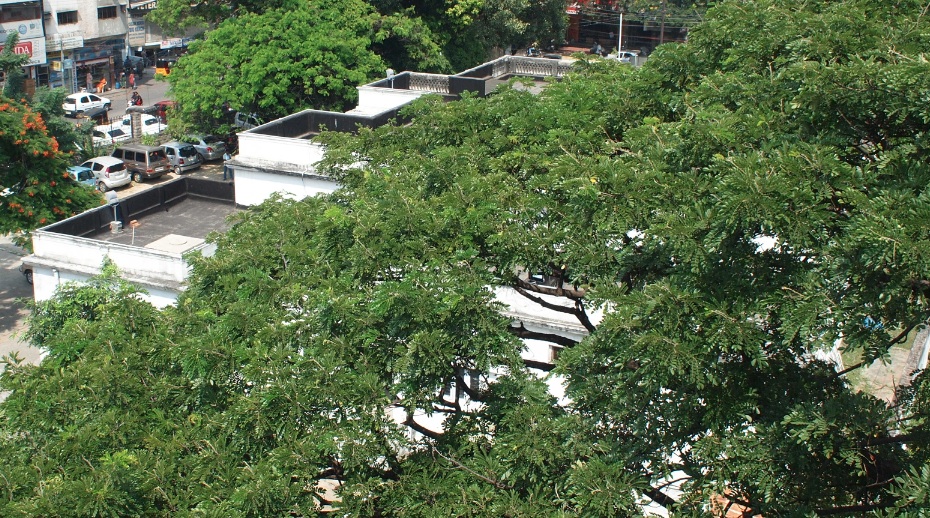
In the last few years with all changes that our University has been going through, the GT campus has undergone many changes. The premises occupied earlier by the SN School now houses our Centre for Distance Education, the Gopal Clinic hosts the Ranga Reddy District’s Jana Siksha Sansthan, and the original GT building is unoccupied. But it is in sad disrepair, the years of poor maintenance, whimsical remodeling, inappropriate conservation measures having taken their toll. The building has its beauty and charm, but it takes little to see that there is much more under the layers of lime. The view from the top shows the tarring of the roof- and in the past few years, the city has grown, buildings coming up cheek by jowl, painted which ever way, unplanned and chaotic- the image at the top of this post is the view from the roof of our building housing the CDE.

About a month ago, Anuradha Reddy of the Hyderabad chapter of INTACH, the Indian National Trust for Art and Cultural Heritage and her colleagues came to GT to talk with us about what they could do, and we initiated a conversation on what conservation measures we could take to preserve the building. More, what we could do to restore the building to its earlier condition and to make it take its place among the other marvelous buildings in the city. Restorations of the Falaknuma palace, Chowmahalla, Purani Haveli and other heritage sites have brought back a lot of pride to Hyderabadis!

Well, INTACH is helping us assess what needs to be done. A conservation architect is coming over to advise, and together we hope to make the main building a worthy addition to the landscape of our city. After all, we do still have a tree planted by Mahatma Gandhi at GT…

What more can we do there? How do you see the GT campus playing a role in the life of the city? Ideas and suggestions would be very welcome-

One last thing. The Wikipedia entry for our University is really incomplete… It would be good if it can be updated and corrected- and I guess that’s up to us to do it. Any volunteers out there?

Cameroon Diary

NODYCOS-2011 is the International School on Non-linear Dynamics in Complex Systems, being held at the University of Yaoundé. Having agreed to come here earlier this year to lecture on the applications of Nonlinear Dynamics to Biology, I found myself on a flight from Brussels to Nsimalen last Friday.

All the things that could go wrong did, of course. I had not had my yellow fever vaccination (so I got it at the airport, much use that). The transportation that had been sent to get me gave up after a long wait- my “visa on arrival” entailed much delay and negotiation and stretched my non-existent French to the fullest, so when I emerged with the visa, there were only predatory taxi-wallahs who homed in on me to take me to downtown Yaoundé for what seemed like an astronomical amount. I capitulated… Je suis fatigué can be used only so often.

The drive had its moments. One thing about living in India, most other places seem like somewhere familiar. On the outskirts, Yaoundé seemed very much like one of the smaller Indian towns, Indore, Tiruchi, or Bhubaneswar some years ago maybe? On the other hand, Yaoundé is hilly, so images of Aizawl flitted by occasionally. And it is also quite French colonial, so Pondicherry came to mind too… Posters proclaiming the gratitude of the President, Paul Biya, for being elected- making this his 29th year at the helm of affairs- festoon the place, so by the time I reached my hotel, I was fully indoctrinated by Paul the taxi driver and tres tres fatigué to boot.
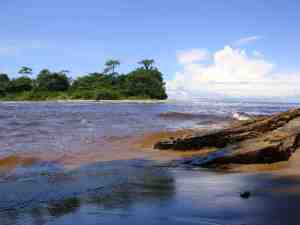
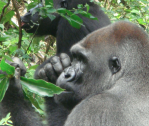
Navigating through this part of the world for the first two days was mostly social since it was le weekend– with a trip to the seaside town of Kribi (with a side trip to a so-called village of the people of the forest), seeing a lowland gorilla close up in a reserve, a canoe (pirogue) ride through a partly submerged forest… And a run in with the militia for not carrying my passport at all times (and that seemed very much like something out of a despatch from Ryszard Kapuscinski).

__________

So much for the pretty beach picture, the work part now. The poster says: NODYCOS 2011, the first school of its kind to be organized in Cameroon (by the ICTP Trieste, Italy) aims at bringing together students and leading experts with diverse backgrounds in applied physics, theoretical physics and computational physics, to share insights on the state-of-the-art of efficient forefront analytical and computational approaches to models governing nonlinear physical processes.

The ICTP in Trieste has played a major role in nurturing physics and mathematics in the developing world, thanks in great measure due to the vision of its founder, Abdus Salam. Its outreach activities are impressive, and this School is another example of what the ICTP has done well in the past (nearly) 50 years. NODYCOS expands to NOnlinear DYnamics in COmplex Systems, a common way in which acronyms seem to be constructed here, phonetics being as important as brevity. Other delightful examples are SOACAM (the SOciete Alimentaire de CAMeroon) and FINUTRASU (the Fako INter-Urban TRAnsporters Union).

Arriving at the University this morning, it was good to see a large group of enthusiastic students. Not all were there to study chaos, it turned out that a few had come- Eid notwithstanding- for their distance education classes. The real surprise for me was that these were students of Amity University in Noida- all taking the e-learning modules in finance, tourism management and other subjects. From what I was able to gather, there were 60 students in Cameroon, and about 500 in all of Africa, and the government had sponsored them for this 3 year course. Other private Indian Universities- Manipal among them- have also heavily invested in the distance learning mode, and much of their outreach is in Africa where the need is large, and an Indian solution is both inexpensive and highly regarded. There is a lesson here somewhere for us…

There was more to learn- in particular about opportunities for African researchers to come to India. Amazingly enough, FICCI and the Department of Science & Technology have initiated the C V Raman International Fellowships to promote scientific cooperation with Africa. There are opportunities for African researchers to collaborate with groups in Universities and other Indian institutions in various areas of Science & Technology. 
Each of the participating African nations have been given 8 fellowships, and these are at the post doctoral, junior and senior levels totaling about 24 man-months. That I had not heard about it until a Nigerian student at the School told me is not clear evidence that the fellowship has not been widely advertised, but still… Given the widespread enthusiasm for the Indian educational system that I see here, the real need and the vast potential, I think this is an excellent opportunity for us to do something meaningful!

__________

I did go around the central part of downtown Yaoundé, chancing upon the few Indian stores that mostly sell mixed goods- a catchall phrase for just about anything from LG TVs to baby clothes. The community is small, but will be getting together to celebrate Gurupurab on Thursday… The Consul General of India in Cameroon, Mr J Ravikumar, has been doing a great deal to further relations between the countries- in particular the effort in e-learning and telemedicine is largely thanks to his initiative. It should be added, of course, that the Indian Government has put in a large amount of money into this- apart from the CV Raman Fellowships, there is the Indo-Africa Virtual University (IAVU) that was announced earlier this year.

Meanwhile, a colleague shared a link to the New York Review of Books’ article by Anthony Grafton, a thought provoking piece titled Our Universities: Why Are They Failing? I found some time to go over it today, and in case any of you have wondered if there is indeed cause for concern, this article gives a special insight into the US university system and its challenges at this time. The essay is a good read and thought provoking to boot. One aspect that I thought that we should keep in mind as we think of growth and change is Grafton’s comment that (in the books he was reviewing) “two points come through with striking clarity. First, traditional subjects and methods seem to retain their educational value. Nowadays the liberal arts attract a far smaller proportion of students than they did two generations ago. Still, those majoring in liberal arts fields—humanities and social sciences, natural sciences and mathematics—outperformed those studying business, communications, and other new, practical majors […]. And at a time when libraries and classrooms across the country are being reconfigured to promote trendy forms of collaborative learning, students who spent the most time studying on their own outperformed those who worked mostly with others.

__________

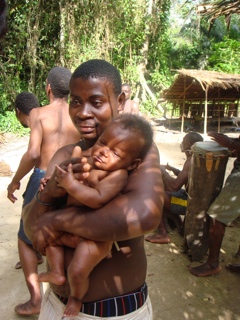
The past few days have been busy with lectures mainly, with something like 80 students, the bulk of who are from Cameroon, but there is representation from other states in the region. 11.11.11 is the last day of lectures- in fact the last day of NODYCOS- and at lunch today I discovered a startling fact. No Ph D student at the University of Yaoundé receives any sort of fellowship. There is simply no equivalent of the UGC’s scholarships for all registered Ph D students, let alone anything like the JRF or SRF’s that enable most students in our country to pursue their doctorates. And, of course, this is a serious impediment to higher learning in an already poor country. In spite of that, there are 100 students in the Ph D program in the Physics department alone, though with this level of governmental support, one can only imagine what other hurdles they have to cross. The thought did, I must say, cross my mind: What would our enrollment be if no scholarships were offered? Both in terms of quality and quantity…
20111114-141216.jpg
Coming away at the end of a week of varied experience, one can only be struck by the similarities of our two situations. A colonial past, a diverse linguistic composition, considerable and visible poverty and inequality. Differences too, and probably these determine the two very different trajectories we have taken. But still, there is a great opportunity here, and I believe it is to our advantage to participate- in some way in this globalized and connected world- by providing opportunities to the Africa that is anxious for and enthusiastic about higher education. Postdoctoral training, in particular, is something that we should be able to offer and with very little effort on our part, this would be very attractive to most of the students here.
Nature@UoH

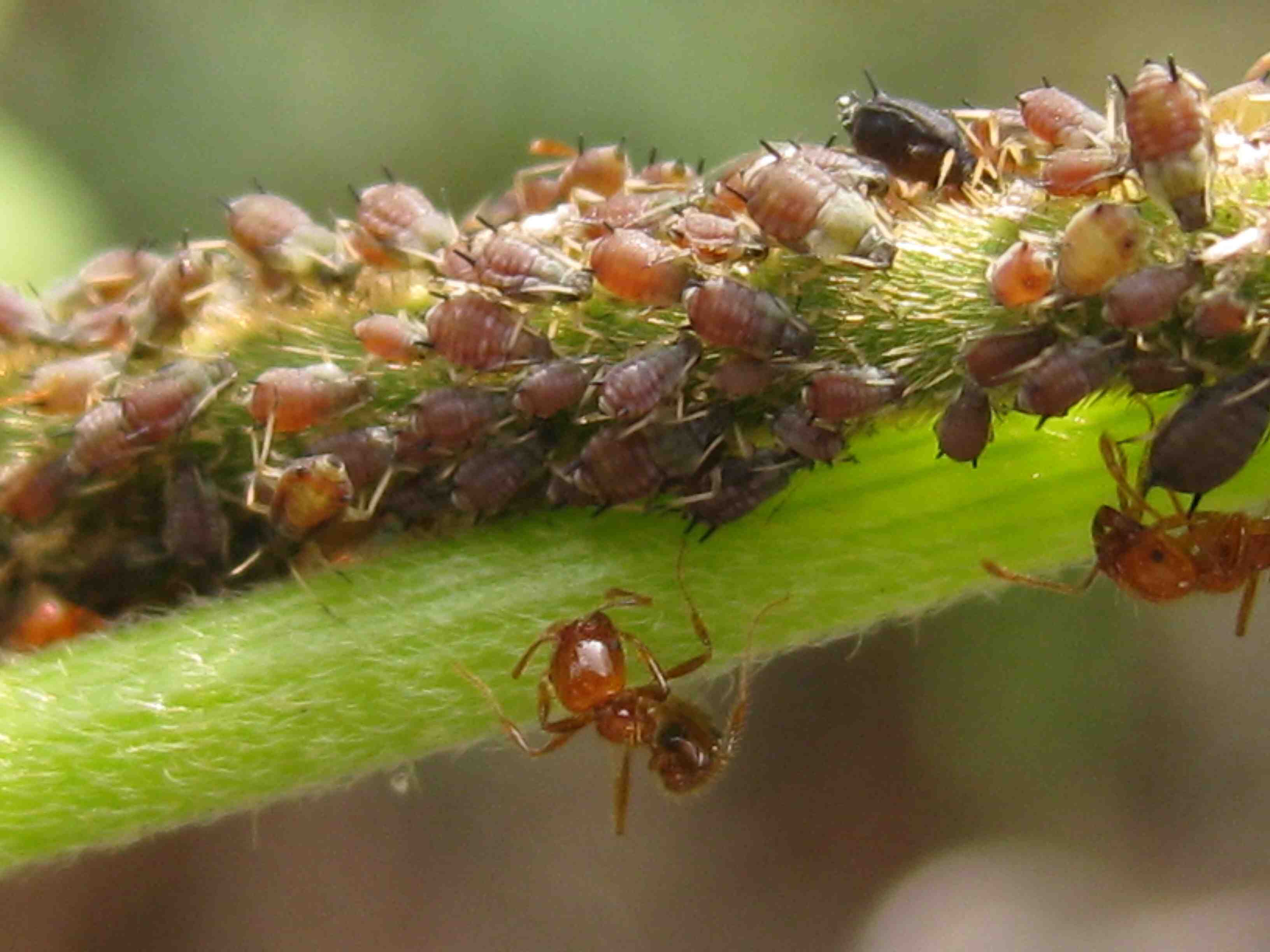
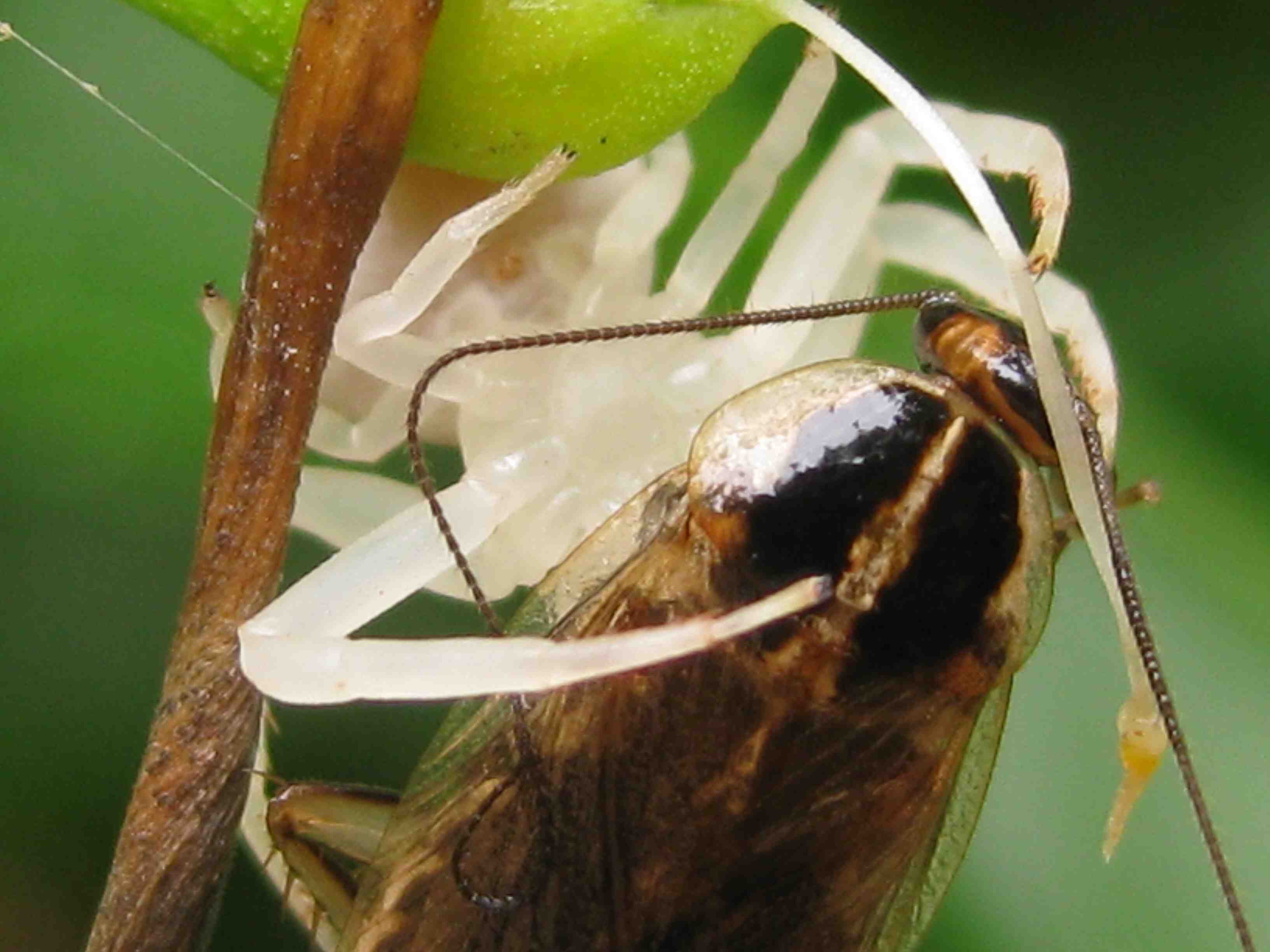
A few days ago, I was taking a short walk on campus when I came across Professor Sudhakar Marathe busy taking close-up photographs of a flower. It was pretty enough but quite ordinary, and indeed quite unlike some of the extraordinary forms of life that he had photographed (and shared) a few months ago. In July he copied me in on a letter that goes: I am attaching pictures of just a few of the 28 different forms of life I photographed today (25 July, not including the various mushrooms that I photographed also) on the University of Hyderabad campus […] the enormous and easily determined overt biodiversity in the campus (Obviously, microlife simply cannot be recorded in this way.)

The place is simply teeming with life: virtually all the pictures I am sending were taken within 15 feet of the Humanities building […] the Administration parking lot and […] the end of the Humanities concourse.

In an earlier mail, he wrote that he “happened to have this camera that very cleverly takes incredibly good pictures of “all things great and small”. It needs much more than a clever small camera to record these images, and what I’ve shown on this page are just a few of an incredible collection of photographs that he has, by his reckoning some 15000 or more. He ran the Nature Club at the University for over 15 years and published a Nature Newsletter for eight years- with some superb illustrations by Prof. Vipin Srivastava.

The campus biodiversity is, of course, huge. Not just in flora, but also fauna, both large and small. Professor Marathe’s inventory of more than 800 species will find a way of being made available to all of us, and this post is just a teaser of what there is. And also an invitation to all of you who care about the present biota of the campus, to send in your photographs or drawings…

The header of the blog now shows one of Professor Marathe’s recent pictures, that of “a small spider just about half an inch long wearing a red crown-jewel, which is actually a parasitic bug (about 1/32 of an inch long); the spider is trying to hide from my gaze (or the camera’s gaze at any rate), yet curiously looking round the stalk of a vine on which I found it to see what kind of spider-gobbling creature I might be. If you look carefully, you will even see the two thin and pale antennae of the tiny parasitic bug!” And elsewhere, the School of Humanities building imaged in a water drop on an oleander flower.

Like Blake, he is able to see a world in a grain of sand, and a heaven in a wild flower…

And through his eyes and camera, we also see many other wonders. Enjoy!

ΠΑΝΕΠΙΣΤΗΜΙΟ

Traveling in Greece (many years ago, before the Eurozone crisis and all that) one of the few words that I was encouraged to recognize was ΠΑΝΕΠΙΣΤΗΜΙΟ, the word for University (for the somewhat pragmatic and mundane reason so I could identify the signs to find my way back to my host…).

PANEPISTEMIO... It has always struck me that it’s literal meaning, as a place where “All the body of ideas that determine the knowledge that is intellectually certain at any particular time” has a satisfying completeness. And so much more appropriate for what it is we should want to be… “University” is too all encompassing and doesn’t quite focus on the knowledge that we hold so dear as part of what defines us.

This introspection comes at the cusp of the 11th and the 12th five-year plans, when it is time to start reflecting on where we want to be in the years to come. How we visualize our University in the next ten, twenty years… that determines the course of action we must take now. What new branches of knowledge we should propose to explore, what new fields of study we should embark upon, and what new disciplines we must forge…

The University is today composed of 10 Schools of study that contain, severally, some 15 or so Departments. And in addition, there are Centres both inside and outside the School framework. What we study, how we train the new generations, how we organize ourselves are all issues that testify to our sense of common purpose. To convert our institution into one where all disciplines flourish will take some doing, and given our framework, may not even be possible now. But the Pan-Epistemic ideal is one that I believe is worth striving for.

We should try. Do we have too few Schools? How many is too many? What do we need? Where are our (many) gap areas?  Is our structure robust enough to allow us the academic framework we need? What can we do to strengthen this? How many students should we have? Do we teach enough? Too much? All questions that are easy enough to pose, but not quite so easy to figure out sustainable answers to… I know I have posted along somewhat similar lines recently, but given that this is a constant preoccupation, I guess some repetition is inevitable. And of course, its not all repetition.

One general aim we need to keep in mind is that we should increase the number of students on campus. After we have built sufficient hostels of course, but the fact is that we must increase the size of the student body. That can’t be done simply by increasing the numbers in each class- sometimes there are just not that many takers for a given subject- but we also need to worry about what academic disciplines are attractive for those seeking education.

A number of cross-disciplinary chimeras have arisen in recent years, some with the benefit of clergy and some without. In the fitness of time they will- like the languages I wrote about in an earlier post- evolve into other disciplines, some will die, others will be born, but we do not, now, have the luxury of time. Some response to let me know what you feel is needed could help us evolve a plan to present to the UGC when they decide to ask us to make a proposal for the XIIth Five Year Plan. More “Community College” type courses? An emphasis on issues of the environment? Particle physics? Gender Studies? More M. Tech. programmes? Less of them? P G Diplomas? Brain science? Post Genomics? Let me know.

DIY Ph D's

P. Sreekumar of the Department of Dravidian & Computational Linguistics at the Dravidian University in Kuppam, AP, sent out an anguished email on the University Grants Commission (UGC) that has lifted a two-year ban on distance M Phil and Ph D courses.

The move comes after widespread protests by various universities. Many Open Learning Universities like IGNOU were protesting the ban on the ground that their respective laws, passed by Parliament or legislatures, allowed them to offer such courses.


Speaking on the development, IGNOU vice-chancellor Rajasekharan Pillai said, “We will follow the rules but our regulations are already stricter than those of the UGC.”
UGC held a meeting on the issue last month, deciding to lift the ban. “An open university may be permitted to conduct MPhil/PhD programmes through distant education mode subject to condition that it does so strictly as per the provisions of the UGC Regulations,” said the minutes of the meeting.

Although, UGC has lifted the ban but it has put another condition for Phd — the principal guide should be from the open university. The UGC had clamped the bar by notifying a rule — the Minimum Standards and Procedure for Awards of MPhil/PhD Degree Regulation — in 2009 saying research courses in the distant mode were of poor quality.

The regulations had put a question mark on the future of nearly 10,000 students pursuing such courses across the country.“There should not be any blanket ban on MPhil or PhD in distance mode. If institutions meet the required quality parameters, they should be allowed to offer such courses,” said academic M. Madhava Menon, who has been asked by the HRD ministry to draft a policy on distance education. He said he would submit his report next month.

Inadequate infrastructure of many open universities is also a concern for carrying out research work. A UGC official said the commission’s regulations were silent on the facilities, and a panel headed by academic S. P. Thyagrajan had been set up to suggest the requirements. “We will meet on September 15 to lay the guidelines,” Thyagrajan said.

Well, its one step from here to so-called Universities like those Internet Academies that offer you a Ph D for $725. As one of these advertises,  In order to get your desired degree, you can start now by getting registered with W**d University. Once you get registered, your email address will become your log-in id for future use and you’ll always provide the same password as you are doing at the time of registration. This information will allow you to return anytime and continue with the process of getting your desired degree from W**d University.

We wish you good luck and thank you for choosing W**d University to start your journey towards success.

I believe the similar facilities are offered in various bucket shops in Ameerpet. You can easily purchase “original” theses in any subject of your choice, and at any level you desire… from the M A/ M Tech upwards, to the D. Phil. And submit them to any UGC University of your choice.

Whither Classics?

An article in a recent Sunday newspaper reminded me once again of a passionate and well reasoned article by Sheldon Pollock, Crisis in the Classics that was published earlier this year in India’s World, a special issue of Social Research: An International Quarterly.

The paper can be downloaded freely from the above link for those of you who many not have read it yet. The main thesis of the paper- at the risk of condensing an argument that is already forcefully minimal – is that there is a dangerous decline in scholarship in the classics in India, dangerous enough that its extinction is more or less assured.

The fate of the soft subjects in a hard world is a matter that we- at the UoH in particular- should be concerned about, in part because we have at least three Departments that are players in the classics game, Urdu, Telugu and Sanskrit. And a whole Centre that concerns itself with Endangered Languages.

The danger is near. As Pollock puts it: There have been no major Sanskrit projects in India since the completion of the critical edition of the Ramayana at Baroda more than 30 years ago. All the great classical series (such as Anandasrama, Trivandrum, Gaekwad, Madras) have been more or less discontinued, and as a result the manuscripts in those collections are no longer being published. Indeed, there have been few new Indian editions of complex Sanskrit texts at all from among the scores of important manuscripts that lie unpublished in archives. In the area of hermeneutics (Mimamsa), for example, I know of no one in India today capable of editing works like those edited just a generation ago by P. N. Pattabhirama Sastry or S. Subrahmanya Sastry…  I have not encountered a single PhD dissertation on Sanskrit in India—and I have seen many— worthy of publication by a Western university press.

The situation is no different in the other classical languages […] Our core group of colleagues was looking for others to join us who possessed a deep historical understanding of a regional language, conceptual skills, and the capacity to communicate their knowledge effectively. We were able to locate only four qualified scholars in India, and identified no one for a host of languages, including Assamese, Marathi, Newari, Oriya, and Panjabi.

Assamese, Marathi, Panjabi, Oriya- these are hardly languages we think of as being on the brink of extinction, but the lack of scholarship in these could eventually drive them to the brink. Indeed, some of our languages have already vanished, or been relegated to kitchen languages as the linguist Loreto Todd calls them- spoken only in private or in fields, not worthy of a literature.

My erstwhile colleague (at JNU) Anvita Abbi’s efforts to preserve the last traces of the Great Andamanese (GA) have been heroic but futile. She explains that about ten languages form the present Great Andamanese language family, and the number of speakers in some of these such as Bo (one of the last speakers of the GA language is shown in the poster on the left) now number five or so. The language groups are complex- Anvita’s work is on the Koine language, a mix of four varieties of the present GA language. One can only wonder how soon there will be none left, no varieties, no speakers, no GA.  The announcement of a talk she will give in London next month is poignant.   Breathing life into a dying language: Documenting Great Andamanese. The Andaman Islands in the Bay of Bengal are home to three highly endangered languages: Jarawa, Onge and Great Andamanese. Professor Abbi will share her experiences documenting them and compiling a multilingual multiscriptal interactive dictionary revealing the ecological and archeological signatures of the original communities and their ties with the environment. An ethno-semantic and ornithological account of the local birds and their names in the Great Andamanese language features in the dictionary and in the book Birds of the Great Andamanese co-authored by Professor Abbi and Dr Satish Pande. The talk will include examples of original sound and video recordings of the last native speakers of Great Andamanese.

This may well have been the history of the world since the tower of Babel- one language gives way to another, one evolves into another, some die, new ones are born. So why should we care? To misquote Elizabeth Barett Browning, let me not count the ways, but instead appeal to both art and science. Each time a language dies, something of humanity dies with it, some common collective memory vanishes… Abrams and Strogatz modeled the death of languages mathematically in a paper in the scientific journal Nature a few years ago. They end their letter with the analysis that to prevent the rapid disintegration of our world’s linguistic heritage, some simple steps are possible: The example of Quebec French demonstrates that language decline can be slowed by strategies such as policy-making, education and advertising, in essence increasing an endangered language’s status. Not a particularly deep or lateral conclusion, perhaps, but still, something that we can heed at the University, since we do care deeply about this issue in the context of preserving our heritage.

There are many other disciplines that are undersubscribed, but more on those another time.  As also on whether we need a “western” press to validate the scholarly quality of our own work, and why there is not University Press of any standard left in India…

Finally, in case any of you are wondering what that image at the top is, this is the atoll near one of the most remote places on earth (and which cannot actually be seen in the image, its too small a speck), the island of Furudu. Ever since I heard of it on the CBS show 60 Minutes many many years ago, this has always struck me as a metaphor for planned extinction: Exiles are consigned there, and typically, forgotten.

Que sera

Much of the last week was taken up with conferences and conclaves, meetings in Delhi and Washington. I am only slowly getting familiar with the routines, the ceremoniality of it all, the somewhat studied smiles and pauses. The speeches. But in the midst of it all, there are things that stand out, as did an excerpt of what one of the senior administrators at Stanford said last week, when talking about quality.

In his book, Rabi, scientist and citizen,  John Rigden tells of when Dwight Eisenhower was President of Columbia University, and Isidor Rabi (picture on the right) was awarded the Nobel prize for Physics. As Hans Bethe (another physicist and Nobelist) recounts, Eisenhower met Rabi and said “Professor Rabi, I congratulate you on the Nobel Prize, and besides, I am always very happy to see one of the employees of the University…  So Rabi drew himself up to his full height of five feet five inches and said,” Mr President, the faculty are not the employees of the University. They are the University!

I don’t know what else I got out of that talk, but this made a great impression on me, as I imagine it did on Bethe, or on Rigden, or for that matter, on Eisenhower. The sense of identification, the sense of authority, or the sense of responsibility. This so defines a teacher, and in the end, this so defines a University.

The next few days in Washington were an eye opener in more ways. Visits to the University of Maryland in addition to The summit with Mr Kapil Sibal and Mrs Hilary Clinton. The U of M is one of the “land grant” universities, having 1250 acres given by the state for the purpose of education (sound familiar??). They started in 1857, so that is quite a headstart on us, but still… they now have about 3000 faculty, 39000 students,  a similarly impressive number of departments and subjects. Given, as I learned, that our (by which I mean the country’s) placement deficit with respect to the US is 100,000 student seats, it make one think again of where we should be positioning ourselves at UoH. On the size front, we are a tenth of the faculty and a tenth of the student body but at the same nominal area. But we serve a population that is at least 10 times as many… Without making unfair comparisons, I still think it should be possible for us to do better on the numbers game.

But more. A serious question as to how we should increase numbers is on the cards. First off, we need better infrastructure, both for teaching and for student hostels. And for faculty housing. But after that. What should we be teaching? What are the areas where we should be investing intellectually? What is important for us, as academics? What is of interest to us as a nation? What subjects, what areas of human enquiry are of relevance?

None of these are unloaded questions, I realize, but we do need to start thinking along some lines. The 12th Plan is upon us, and if we want this to be a plan in any sense of the word, it is important that we start thinking. Among the foci of discussion at the summit were issues of skill development, of community colleges. And yes, the usual dual degrees, twinning programmes, semesters in India and other intersections were talked about but in somewhat tired voices. What was really urgent is the final realization that in India, we will soon have about 200 million young men and women in search of an education, and it will be our lot to educate them as best as possible to take their place, not in India, but in a world that is even more borderless than we see it now.

How will we prepare ourselves for the challenge of providing a skilled workforce to the world? One thing is for sure, we need new strategies for educating more people, in ways that they want, and in ways that are effective, using methods that may not exist… yet.

What will the University of Hyderabad be like in the year 2024, when we are 50? I suppose that is up to us to determine, now.

Inside Higher Ed

Here is a link to an article that appears in Inside Higher Ed, the online Higher Education magazine. I was in Washington for the India-US summit on higher education, and Scott Jaschik, the magazine editor came by to chat. Some words got left out of the last quote, but the article gives you an idea of what I thought the summit was all about. And a bit more than that, of course.