IMBY


The Urban Dictionary will tell you that NIMBY is an acronym for Not In My BackYard, to describe the attitude of those who will want to benefit from the advantages of a particular action, but who find that the disadvantages are suddenly unacceptable. The usual situation where nimbyism is typically decried is in an urban setting- opposing a road or a shopping mall coming up too close to ones home, for instance. Of course things are not always a clear case of either/or, so there can be both good and bad connotations to being nimbyistic.

By extension, IMBY describes the opposite attitude. Which would, of course, be acceptable in many situations, especially when there is a clear idea of the greater public good. Regrettably though, and this is the subject of the present post, when it comes to the matter of waste disposal on our campus, imbyism is simply unacceptable. The photographs here are of various sites in and around the central part, behind the Science complex, and near the School of Humanities. More could have been taken, and some of them would illustrate that even less desirable stance: IMNBY or In My Neighbour’s BackYard!

Many of you will have noticed that there is a concerted effort being undertaken to “clean-up” the campus. The quotes are there to underscore the fact that it is not an effort to prettify  the campus in some very artificial way- as superficially attractive as a manicured campus might be, it is not the way our UoH campus is. However, with the dense undergrowth that has been uncared for for many years, the foliage has covered a multitude of sins, mostly that of the way in which we dispose of our waste. Everywhere one can see discarded bottles- both plastic and glass, styrofoam packaging, all manner of trash and garbage. A catalogue of what we throw away would reveal a little too much of ourselves… and I will not go into that. But it can all be seen and sometimes the close proximity of a garbage can makes it all the more tragic.

One spot that worried me a great deal is the pool that has formed behind Gopes, one that is dangerously close to a water source. Waste management on the campus is a joint responsibility – if the system is to work in any manner at all, it needs constant supervision. Drains need to be kept flowing, so trash needs to be segregated and disposed of properly… while making sure that blockages are removed periodically. There is no other solution- we need to work together on this, and on a continual basis.

In the end, it is our campus. Emphasis on our. And keeping it clean and safe is something that all of us should want. So while it is nice to have slogans- Clean Campus, Green Campus or Mana Campus, Mana Hridayam and all that- its essential to go beyond them and see that public spaces on the campus stay unpolluted. That would be the best way we can make the campus habitable for all its denizens, the flora and the fauna, in addition to us…

Earth Day @ UoH

Mark the day, 22 April (Sunday). Its Earth Day.

Mark the venue: School of Humanities Auditorium, University of Hyderabad

Mark the time: 5:00 PM

The UoH Film Club  will screen the  first One Day on Earth Motion Picture. …This one was shot on location on 10 October 2010 (10/10/10) across the planet by documentary filmmakers, students, and other inspired citizens will record the human experience over a 24-hour period and contribute their voice to the second annual global day of media creation called One Day on Earth. Together, we will create a shared archive and a film.

This is a unique effort to share the human experience across borders, by showcasing the amazing diversity, conflict, tragedy, and triumph that occurs in one day. We invite you to join our international community of thousands of filmmakers, hundreds of schools, and dozens of non-profits, and contribute to this unique global mosaic. One Day on Earth is a community that not only watches, but participates.

The above quotes are from the ODOE website where you can find more information about the film, but do come watch on 22/4/12 at 5:00. The event is brought to you by the UoH Film Club.

Mee Kosam: UoH Podcasts

In an effort to take some instruction out of the classroom- both for the teacher and the taught- Vasuki Belavadi of the SN School’s Department of  Communication has set up our new Podcast site, uohpodcast.in.

The About Us page says: UOH PODCASTS features audio and video content from University of Hyderabad, India’s premier central university. It provides you with access to audios/videos of excellent public lectures by eminent personalities, interviews, comments by experts on various issues & tutorials. Some podcasts featured on this website are also from Bol Hyderabad 90.4 FM, the university’s campus radio station. Content on this site is being updated regularly. All content on this website is free for download.

These podcasts can be listened/ watched either online or downloaded to your computer/ mobiles/ mp3 / video players. You can also listen to them on iTunes.

One one page there is listed, as of now, a set of interviews with some recent eminent visitors- Robert Kanigel, Leela Samson, and David Shulman and Radhika Hegde, but this is just a representative fraction of the really exciting speakers we have had in the last few months… Clearly we need more.

In addition, there is a set of 5 minute long lessons, Spoken Telugu. Put together by Vasuki along with Pawan Kumar Pammi of the Telugu Department and a group of enthusiastic RJ’s at BOL FM, these bit sized instructional programs are an engaging way to learn the language. So far I have managed to learn to count along with Dipu and Ashwathi.   Their charming promo for “Your Daily cup of Telugu” made me listen, not once, but at least padi times- Feel left out amongst your Telugu friends? Want to learn spoken Telugu? This series of podcasts will be a fun, intuitive way of learning spoken Telugu. The best podcasts on the internet to learn the language as it’s really spoken. Authentic.

Clearly this is site we’d like to build up, other lectures, other languages, anything you’d like to learn or just listen to… In the end, this is really for you- the University community, and more generally, for everyone, so please write in to the podcast team,  at admin@uohpodcasts.in and let them know what you would like to hear.

Also check out Vasuki’s Blog to learn how to make a podcast! Apart from a zillion other things in communicating. Great byline, Learn to Learn!

Finding your Mojo

The other day when discussing the general state of affairs with a group of colleagues, I was talking about one of the main problems confronting a University that is growing older, namely finding relevance in the face of that endemic cynicism that comes with age.

Call it what you will – Finding your mojo, finding your groove, its about getting back something that was once there, a remembrance of things past, the way we were.

Apropos of which, a festival like the one we just experienced, last week’s SUKOON was, in many ways, refreshing. Although I felt it was poorly timed (it was too hot during the days, and many campus children had Board examinations) it was a good opportunity for students to get together and participate in group events, compete, interact. There were small things that could have been done differently, and  maybe next time around they will, but all in all, such an event focuses the vibrancy and vitality of our student life.

That said, there is a need for us at the UoH to find our mojo once again. Seriously, the urban dictionary will tell you that the word means “Self-confidence, Self-assuredness. As in `basis for belief in ones self in a situation’.” And more, but thats enough for now- its really the vibrancy and vitality  that this University had in plenty at one point in time. Maybe its just that we were younger then, or smaller, or just plain newer. But given the fact that our students change every so often, there should be a freshness that comes with this sense of renewal, something that should keep us on our toes and evolving.

And, of course,  it had best come from within.  But some things are, however, not for the asking, so one does need to make an effort. I, for one, am sure that it is there…

The Shame of it…

Two youths ensnare deer, kill it, split the meat to consume some and sell [the] rest.  To have to read this in The Hindu recently, the article being accompanied by a gruesome photograph… not at all like that on the left, and on Ugadi, was sad.

Some points. The crime has been investigated by the  anti-poaching squad of the Forest Department. The University will let the law take its course and allow civil authorities to take whatever action that is appropriate. According to the squad officials, the spotted deer was trapped, killed and the meat eaten in part and sold in part.  A case will be booked against the perpetrators under the Wildlife Protection Act of 1972, and they face a three year jail term and a fine of Rs 25,000.

Too little.  The spotted deer, Chital, is a species protected under the Wildlife Protection Act. So when the Hindu says The sprawling university campus with lots of green cover has a presence of wild life, the irony is not lost on us-  who knows how much will last and for how long.

There is an urgent need for us in the University community to take steps to ensure that this act does not go unpunished, especially since the perpetrators are from within. This is the most difficult part of it… When those who live in this wonderful campus and partake of an environment that others can only envy from afar, how can we tolerate such actions that destroy the environment in this most dastardly manner. Clearly also, this is just the first time that the duo have been apprehended, and surely not that first time that they have caught and killed deer- it seems that the remaining meat was stored in the home refrigerator. If indeed it was just the duo- from what little one can glean from the newspapers, there may have been more persons involved.

I know that many of you care deeply about the campus and its environment. Please act.

Outright killing of a wild animal is one thing, but we also kill other animals slowly. The vanishing wildlife on our campus is evidence of either neglect not so benign, or of our introducing other species that change the balance. Feral dogs and cats, for instance. And, of course, seeing animals on campus these past few days that provide “rides” has not been much fun, I must confess. I don’t really see the need for this in a campus festival, and particularly in as environmentally sensitive a campus as ours. Or is this just an illusion that we care? My heart says NO! but my head says maybe…

Another act of poaching that should not go unnoticed. A research scholar has been nabbed for identity theft, stealing debit/credit card numbers and pins, and using this to make online purchases. Read all about it, again in today’s  The Hindu. And this also has points of irony- we have just put together a one-year diploma course in Cyber Security, to be launched shortly…

Sadly, this is us.

The Art of Giving

Some of the English dailies in Hyderabad carried a small news item on the 9th of March, the significance of which far exceeded the space they gave to the story. The Times of India said Malladi Subamma, a city-based writer and feminist donated Rs 36 lakh to Centre for Women’s Studies, University of Hyderabad, on the occasion of Women’s Day on Thursday. The contribution was made towards construction of a new building for the centre located on HCU campus.

A rationalist and humanist, Subamma, has been elected to head the AP Rationalist Association several times. She also has about 110 books and 500 articles on women’s issues to her credit. She has acted in films too. Rekha Pandey, coordinator of the centre, said, “It is not that she comes from a very rich business class family but that she could take this decision speaks volumes about her commitment to the cause of women.

while The Hindu‘s headline (the accompanying photograph dates from The Hindu also, but from a few years ago) was

MALLADI SUBAMMA DONATES RS. 36 LAKH

Well-known social worker and women’s activist Malladi Subamma took the lead and donated Rs. 36 lakh for the Centre for Women’s Studies, University of Hyderabad (UoH), on Thursday. The cheque worth Rs. 36 lakh was handed over by Ms. Subamma to Vice-Chancellor, UoH, Professor Ramakrishna Ramaswamy. The donation is towards building a centre, which will be named after her and will be dedicated to teaching and research on women.

“We value the contribution a lot for the fact that this donation has come out of the personal savings of Ms. Malladi Subamma which she created by selling all her property and jewellery.”

And thereby hangs a tale.

What is remarkable about the donation is the spirit with which it was given, a personal gift out of her savings, for supporting teaching and research in a public University. This is extremely rare in the Indian context, at least at this level. Smaller donations are common enough, and very large endowments are also common, especially from corporate houses or alumni donors, but to have a citizen of Hyderabad donate such a large amount, to a University with which her association was tangential at best, can only be described as an act of pure generosity.

Her act should also help us reflect on the role of the University in civil life. While we are a central university, we are also embedded in the matrix of Hyderabad. As much as we need the city to interact with us, to recognize the value we bring to it, we also need to contribute to the intellectual life of the city and help it to grow in ways that Hyderabad may not have realized. More participation by our teachers and students in urban matters, outreach by way of lectures, events, continuing education… There is no limit to the spheres in which we can link with the city, and I believe that we will also then see more of the citizenry contributing to our growth and development, like Malladi Subbamma, and also perhaps in other ways.

And then, in addition to being the University of Hyderabad, we can also learn to be a University for Hyderabad…

Aotearoa


Aotearoa is Maori for the land of the long white cloud, New Zealand. I’m on a week’s visit here courtesy the UGC, to see their eight Universities: The University of Auckland, AUT (the Auckland University of Technology), Waikato, Massey, Victoria, Canterbury, Lincoln and Otago.

The long white clouds  have been playing hide-and-seek until the last few days of the trip. Many days looked more like  the picture on the right, a set of dark grey clouds that seemed to follow the delegation wherever we went. However, this was briefly graced by an unexpected rainbow one evening…

It has largely been a week of discovery- I have known less about New Zealand than is warranted.  Especially Otago- the University we visited on the final day. The southernmost University in the world, this is also NZ’s oldest university, very research intensive. The first people I met immediately asked after our School of Chemistry and our Centre for the Study of Indian Diaspora!

The manner in which universities here are funded is largely indirect: the Government essentially fully funds the students who are then charged whatever it takes to give them an education. There are some advantages to this scheme- the entitlements become clearer- and the Universities have more flexibility in what they can do. In addition there are other direct funds, of course, but by funding students directly, this makes sure that the responsibility for education is shared.

Small is beautiful might well be this country’s byline, but even so, visiting 8 universities in 5 days makes for a rather rushed visit. Nevertheless NZ, for a population of 4 million people has 8 universities, while we with 1200 million people, should by that scaling, have 2400. In reality we have only about 600 in all- central, state, private and deemed. So there are many miles to go, and much to learn from others.

Sometimes the unexpected. In Victoria University in Wellington, the Faculty of Humanities and Social Sciences includes, among other disciplines, Art History, Film, Theatre and Media Studies, Nursing, Midwifery and Health, History, Philosophy and International Relations, Linguistics… Asian Studies, Literary Translation and even a University Press! The coexistence of all these areas under one umbrella is not as uneasy as one might imagine, at least that was the view presented… But even allowing for some latitude, our ideas of trying to federate the different centres that exist at the UoH should be viewed as an effort that is not without precedent or parallel.

One area that all the Universities highlighted was their efforts to include Maori into the mainstream of all efforts- academic and cultural- within the institution. Preserving the Maori language is one area where we can learn how modern tools can be used to keep traditions and cultures alive. This is a language without a script like many of ours, and seeing the loss of stories, traditions and culture if the language falls out of use has motivated all NZ universities to set up departments of Maori Studies. Our efforts at UoH have had similar foci in the Centre for Endangered Languages and Mother Tongue Studies and in the Centre for Dalit and Adivasi Studies and Translation. Perhaps there is something that we can learn from them, and they can learn from us in this area…

One phrase that kept recurring in conversations across the islands was that this was a country that “punched above its weight”. Certainly, that comes through- in fact this week’s The Economist points out that NZ has as many diplomats and diplomatic missions as India does, being about  1/300th as many in population, and some similar fraction in terms of area. Their Universities have a similarly large international presence, more than the numbers would warrant. I know these are not quite the right comparisons, and some things scale well while others do not, but it does seem that we do not always punch above or even at our weight. Mostly below, and even when we don’t need to.

The common colonial past  is reflected in the names. On the drive from the airport into Auckland city, one could see a sign for Khyber Pass Road, and Wellington has a suburb named Khandallah, with Bombay Street… There is an Indian diaspora that dates from the 1860’s and more recent migrations, of course.  There’s clearly a wealth of opportunities here for some serious academic engagement…

The Hex

I have been struck by the fact that there are relatively few places where students (or anyone, for that matter) can sit on the UoH campus outside an office, classroom, or seminar hall. I know that there is Gopes or the Shop.Com, or any number of rocks where people congregate… but still.  A campus should have places where people can meet- to discuss, interact, debate… any number of things that one has all the time for in these years, and less time for afterwards… Anyone who has been anywhere near JNU knows of Ganga Dhaba and how it has given aspiring debaters a chance to cut their ideological teeth…

The central hexagon (or is that a depiction of benzene??)  in the garden in front of the Science Complex has been gussied up over the past few days: the garden has been cleared, the stones have got fixed and cemented into a low wall, the access steps have been fixed, etc.  This is mostly to encourage people to use the park,  to hang out. I hope that the space can be used imaginatively- say by the inventive theatre groups that we have on campus.  Or for music.  And if you have suggestions of what else is needed in this regard- either here or elsewhere on the campus, do let me know and hopefully we can make this happen.

IDPwD

Today, 3 December, is the United Nations  International Day of Persons with DisabilitiesThe Day aims to promote better understanding of disability issues with a focus on the rights of persons with disabilities and gains to be derived from the integration of persons with disabilities in every aspect of the political, social, economic and cultural life of their communities.

Later this month, Shivani Gupta of Access Ability and her team will be on our campus to undertake a complete Disability Audit of all the buildings, roads and other facilities. The Dean of Students Welfare’s office has been coordinating this effort, and our aim is to make as much of the campus accessible to persons with disabilities as possible, and to work for a full access in the future. This means ramps and elevators where possible, but also more.

One other news that is appropriate to share today is that the State Bank of India has very recently given us a 32 seater bus for the campus, specially designed to be accessible to persons with disabilities. This will be for in-campus transport and will run as a shuttle. The bus is not yet on our campus- there is some body work needed on it- but shall be here soon. A great gesture on the part of SBI– many thanks to them on behalf of all of us!

Golden Threshold

The wind of change forever blows
Across the tumult of our way,
To-morrow’s unborn griefs depose
The sorrows of our yesterday.
Dream yields to dream, strife follows strife,
And Death unweaves the webs of Life.


The fragment of the poem quoted above is, as you might have guessed, from Golden Threshold, the book of Sarojini Naidu’s poems that was first published in 1905 (and which still seems to be in print, from Dodo Press).

Sarojini Naidu has, through her legacy played a large role in the creation of our University, most famously by the donation of Golden Threshold, the iconic building in the centre of Hyderabad where the University took seed. I recall coming to the University in the early 1980’s and setting off for the Gachibowli campus from there. At the time, the building itself seemed nice but unremarkable, and since I was there so briefly it made no particular impression on me. Since coming back, its been quite another story…

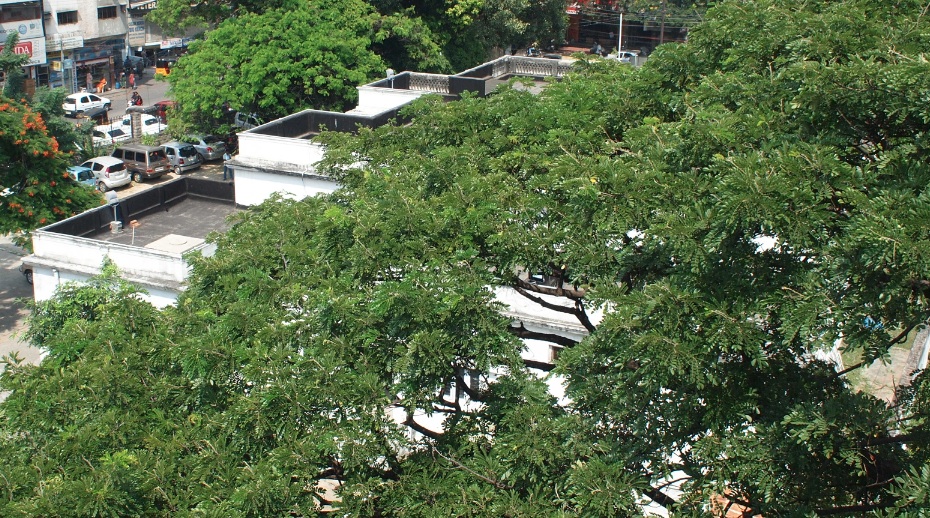
In the last few years with all changes that our University has been going through, the GT campus has undergone many changes. The premises occupied earlier by the SN School now houses our Centre for Distance Education, the Gopal Clinic hosts the Ranga Reddy District’s Jana Siksha Sansthan, and the original GT building is unoccupied. But it is in sad disrepair, the years of poor maintenance, whimsical remodeling, inappropriate conservation measures having taken their toll. The building has its beauty and charm, but it takes little to see that there is much more under the layers of lime. The view from the top shows the tarring of the roof- and in the past few years, the city has grown, buildings coming up cheek by jowl, painted which ever way, unplanned and chaotic- the image at the top of this post is the view from the roof of our building housing the CDE.

About a month ago, Anuradha Reddy of the Hyderabad chapter of INTACH, the Indian National Trust for Art and Cultural Heritage and her colleagues came to GT to talk with us about what they could do, and we initiated a conversation on what conservation measures we could take to preserve the building. More, what we could do to restore the building to its earlier condition and to make it take its place among the other marvelous buildings in the city. Restorations of the Falaknuma palace, Chowmahalla, Purani Haveli and other heritage sites have brought back a lot of pride to Hyderabadis!

Well, INTACH is helping us assess what needs to be done. A conservation architect is coming over to advise, and together we hope to make the main building a worthy addition to the landscape of our city. After all, we do still have a tree planted by Mahatma Gandhi at GT…

What more can we do there? How do you see the GT campus playing a role in the life of the city? Ideas and suggestions would be very welcome-

One last thing. The Wikipedia entry for our University is really incomplete… It would be good if it can be updated and corrected- and I guess that’s up to us to do it. Any volunteers out there?