Bloggers of the Campus, Unite!

10168564-the-pen-is-mightier-than-the-swordA blog, Wikipedia will tell you, is a discussion or informational site published on the World Wide Web and consisting of discrete entries (“posts”) typically displayed in reverse chronological order (the most recent post appears first), and that the word itself is a truncation of the expression web log.

The Urban Dictionary is chillingly brutal. Not for them the factual niceties of Wikipedia- in fact the least cruel definition I could find there was that a blog is a recent and disturbing trend on the internet. A blog lets people easily post comments onto a webpage. While blogs have many purposes, some of which can be useful, most people seem to use blogs as a way of having an online diary. These people have such massive egos and are so narcissistic that they believe that other people would be interested in reading their pointless ramblings. Even more disturbing is the fact that many people have such boring lives that they have nothing better to do than to read these stupid online diaries… Hopefully, “blogging” will turn out to be just a fad that passes quickly.

Fad or no fad, blogging does not promise to go away that quickly, although reactions to blogs (including this one) can range from an extreme lack of interest and stifled yawns to something less disengaged that translates into several “hits” or featuring on being freshly pressed.

Be that as it may, I thought that I would bring together all our campus bloggers onto one page, to offer an easy navigation to the different writers in our community. Here they are:

For now just listing regular blogs,  so please let me know of others that are not included here but should be.  Thanks. This is a diverse group, united only in the fact that we all inhabit the physical space of the campus, but still. Only 15? I thought there’d be more…

Round 3 of the NAACcreditation

indexThe results from the NAAC reaccreditation are now out, and our University has been awarded the overall score of 3.72 out of 4. This is lower than what we had in the first round of reaccreditation when we were given 3.89 out of 4. It is disappointing that we have slipped by 0.17, a percentage drop in quality of about 5%, however that may be estimated… From the documents that can be seen on their website, it is clear that with the passage of time the NAAC has gotten somewhat stricter, but that in of itself is little solace, given the effort that went into the preparation for the visit of the peer review team in January.

SMBe that as it may, all of us owe a word of appreciation to the Coordinator of the effort, Professor Sachi Mohanty of the Department of English. He was a veritable one-man army, mobilizing the efforts of so many staff in preparing reports, collecting information, supervising cleaning, painting, and doing the million things that we all saw him do.

As a colleague wrote to him after the NAAC peer team visit, “I want to take the opportunity to congratulate you and your team for an excellent academic presentation and for the efficient coordination and organization of the NAAC visit. We may know the grade/marks later, but whatever these may be, you and your team made the UoH community proud of its achievements.

I would also like to acknowledge and salute your personal commitment, dedication and devotion to the University; it is rare to find this today. You not only put together and presented an academic assessment through the voluminous report documenting the achievements of the various Departments and Centres and Schools but also highlighted the small and big endeavors made by the teaching, non teaching and student community. As a member of the campus residential community I want to particularly thank you for efforts you made to improve our environment and ambience and make the campus a clean and aesthetic place to live in. In ensuring this, you went beyond the call of duty.

we-try-harder-tvlowcost-australia There are some advantages to not being No. 1 – one tries harder to achieve excellence… There will be time enough to discuss what all needs improving at the University- starting with the infrastructure, both physical and academic. But we should find both the time and the will to bring about some real changes, to earn the higher grades that we all know that we are capable of. Till then, we should keep trying.

See an interview on the local tv station: http://www.youtube.com/watch?v=57gT5J8wrxE#aid=P-sgiBrV7IE

CKN: The Campus Knowledge Network

Yesterday’s Distinguished Lecture by Ashok Venkitaraman was exciting in more ways than one. First thing- it was a superb lecture. Great material, excellent presentation, very thought provoking and truly inspiring. And the best part was that you can see it again, here. And again. And tell your friends they can see it via the National Knowledge Network (NKN) all over the campus, and all across the nation.

mapThe NKN is a state-of-the-art multi-gigabit pan-India network for providing a unified high speed network backbone for all knowledge related institutions in the country. The purpose of such a knowledge network goes to the very core of the country’s quest for building quality institutions with requisite research facilities and creating a pool of highly trained professionals. The NKN will enable scientists, researchers and students from different backgrounds and diverse geographies to work closely for advancing human development in critical and emerging areas.

This is just the beginning, I hope. We should have all our Distinguished Lectures made available to all Universities on the NKN, and as you can see from the map on the right, that network is pretty extensive. In some ways this would be better than just putting them on UoHTube, but since it is in addition to that, it only widens our range.

inaugural_lecure_sk_udgata_140214

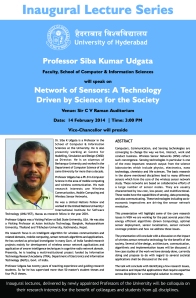
Our Campus Knowledge Network needs strengthening, though. Too often our ivory tower is actually more like a set of ivory minarets, each housing a School, Department or Centre, isolated even from each other. To that end, starting this Valentine’s Day, the University begins its Inaugural Lecture Series, an ongoing set of colloquia that will be delivered by newly appointed Professors. These lectures are to be very general and accessible to colleagues from all disciplines, and are open to students and faculty from all across the University. The first of these will be given by Professor Siba Udgata of the School of Computer and Information Sciences: February 14, 2014 at 3:00 pm in the Raman Auditorium.

Siba works on Wireless Sensor Networks, crucial to many aspects of the ubiquitous computing environment that we inhabit. A great opportunity for us all to learn about the work that he and his group are doing in the area of green computing among other things.

We do need to cross the many divides that separate the two or more cultures that inhabit our academic landscape, and it requires not just the effort of the lecturer to reach out to a diverse audience, but also the effort of the audience to listen and learn. I hope that our community on the campus can learn to engage with ourselves and the variety of scholarly work that is going on here at home, namely our very own campus knowledge network!

The Palamuru Seven

37On Monday the 27th January, I was in Mahbubnagar,  at Palamuru University, to attend the Annual Convention of the Andhra Pradesh Akademi of Sciences (APAS), to keep an old commitment, namely to deliver the Sitamahalakshmi Memorial Lecture. And I was fortunate in at least two ways…

The first was that I got to see- after too many years- Ranga, aka Professor S Ranganathan who taught us Organic Chemistry so brilliantly at IIT Kanpur. Ranga, who is now at the IICT in Hyderabad, retired from Kanpur after decades of teaching generations of chemists. His classes were wonderful, and he was one of the first to seriously try to get some of us interested in biology- I remember him and Balu (Professor D. Balasubramaniam, also now in Hyderabad, and at the LV Prasad Eye Institute) inviting a number of people in ’73 or ’74 to try to educate us philistine M Sc students of the exciting things that were going on in biological chemistry. Some of my classmates took the bait, but it didn’t work out in my case… But more of that in another post, maybe.

The second was that I got to see seven of our colleagues being inducted into the Akademi at one go- the largest contingent from anywhere to be so elected! In the alphabetical order of the handout, here they are :

Untitled 3

M. Ghanshyam Krishna of the School of Physics was elected Fellow. His work focuses on the growth, characterization and applications of thin films.

Subramanyam Rajagopal of the Department of Plant Sciences, School of Life Sciences was elected Fellow. (OK, so the photo is an older one, and he does not sport the mustache now…) His group is working on bioenergy related to photosynthesis and phytomedicines. His major research contribution was on abiotic stress effects on photosynthesis apparatus of cyanobacteria, algae and higher plants.

Samar Das, of the School of Chemistry, was also elected Fellow. The focus of his research effort is to synthesize metal-oxide based inorganic compounds and to exploit their host guest, ion exchange and catalytic properties.

Pradeepta Panda of the School of Chemistry was elected an Associate Fellow. His  work is on the design and synthesis of various porphyrins.

S Srilakshmi of the UCESS was elected an Associate Fellow. She is a geophysicist, and the only woman in the group.

S Srinath of the School of Physics was elected an Associate Fellow. His areas are Magnetism, Multiferroics, Oxides, Nanomaterials  and  Thin films.

S Venugopal Rao of theACRHEM was elected an Associate Fellow. He does a lot of things, as you can see on his homepage, but to mention a few areas of his interest,  Semiconductor Nonlinear Optics: Optical frequency conversion techniques [Second Harmonic Generation, Sum Frequency Generation, Difference Frequency Generation], Optical Parametric Oscillators/Amplifiers in the near- and mid-infrared spectral region and construction and characterization of femtosecond/picosecond Ti:sapphire lasers.

And in addition, there were many other colleagues from the UoH there: they had already  been elected to the Akademi in earlier years. The President, Dr Ch. Mohan Rao, being an alumnus, made the presence of the University even stronger, and drove home the point that we are the preëminent research university in AP. And, of course, also in the country. Nice!

R-day, 2014

Untitled

Members of the UoH family,

This is the 65th Republic Day that we celebrate in our country. Every year it provides us at the University an opportunity to take stock of the year that has passed and to make resolutions for the year ahead. One of the most important events since the last Republic Day has been the re-accreditation of our University by the National Assessment and Accreditation Council (NAAC) during January 8-11 of this month. This visit by a group composed of our peers gave us a chance not only to look at our achievements in the past five years but also have a chance to clean our campus and put our best foot forward. I would like to take this opportunity to offer my hearty congratulations to the entire University family that came together as one for this accreditation; I would also like to thank the NAAC Chair at the University, Prof. Sachi Mohanty, and his team for guiding us through this process and in an efficient and sensitive manner.

In his speech yesterday, the Visitor to the University, President Pranab Mukherjee reminded us that India is not just a geography: it is also a history of ideas, philosophy, intellect, industrial genius, craft, innovation, and experience. And later on, he added that  Education has been an inseparable part of the Indian experience. I am not talking only of the ancient institutions of excellence like Takshashila or Nalanda, but of an age as recent as the 17th and 18th centuries. Today, our higher educational infrastructure consists of over 650 universities and 33,000 colleges. The quality of education has to be the focus of our attention now. We can be world leaders in education, if only we discover the will and leadership to take us to that pinnacle. Education is no longer just the privilege of the elite, but a universal right. It is the seed of a nation’s destiny. We must usher in an education revolution that becomes a launching pad for the national resurgence.

Keeping this in mind, I would like to reassert that our commitment to enhancing the quality of our education is constant and enduring. The University has had a number of very distinguished visitors to our campus during the past year: Nobel Laureates Amartya Sen and Venki Ramakrishnan, and, among others, A. Paulraj, Sir Tom Blundell, Sir Michael Berry, Aruna Roy, André Beteille, Utsa Patnaik, Richard Gombrich, Rajasekhar Vundru, M. S. Valiathan, Nedunuri Krishna Murthy, Shereen Ratnagar, K. Satchidanandan, Irfan Habib, Mahesh Dattani, Rajeev Bhargava, and most recently, S. V. Raghavan. These distinguished visitors give us, through their lectures and interactions, opportunities to hear the many voices of a democracy, the many voices of scholarship, the many opinions that comprise the body politic and the body intellectual.

Our faculty and students have done us proud: Professor P. Appa Rao was awarded the Rangaswami Prize in Plant Sciences, Dr. Vaitheeswaran the B. M. Birla award in Physics, Dr. S. Venugopala Rao the NASI-SCOPUS award in Physics, Professor S. Kumaresan the Mathematics Teacher of the year award from INSA, Dr. V. Vamsicharan the Amartya Sen Award of the ICSSR in Economics, and the Child and Adolescent Mental Health award for Dr. Thomas Kishore. The University has instituted the Chancellor’s awards to recognize young faculty across the disciplines, and this year we will institute a set of staff awards to recognize exceptional service to the University by our non-teaching employees. There have been a host of other recognitions that our faculty have received in addition to their numerous publications and books.

Several of our students have been recognized for their research and presentations at conferences, both national and international, and P. Shankar, S. Basak and Hanumantha Rao got awards from the K.V. Rao Scientific Society. I would like to commend the Physical Education unit for coaching our students who won the Andhra Pradesh Open Football Tournament, and would also like to congratulate our runners, Mallesam and Vinod for bagging the 1st and 2ndplaces at the Airtel Half-Marathon.

Departments of the University have also been recognized for excellence. The Study in India Programme at the University has been given the distinguished Andrew Heiskell award for innovation in international education. The School of Management Studies has been chosen for the B-School Leadership Award and declared the outstanding B-School in the Southern Region.

In the past year we have translated our commitment to environment into two very useful actions: the first, which many of you would have noticed as you enter the campus at the main gate, is the installation of a small weather station that informs us constantly of the air quality in addition to the temperature, pressure and wind. The station measures the suspended particle matter, gases such Ammonia. Nitrous Oxide, Carbon Monoxide, Ozone. It also measures the rainfall, wind speed, wind direction, solar radiation, and vertical wind speed to assess the mixing height of the pollutants. This will help us to monitor atmospheric pollution on the campus in a quantitative manner. Second, the Library has been made fully dependent on solar energy, a move that has been widely applauded  by universities throughout the country. To a smaller extent, many solar stand-alone streetlights have been installed to improve the security on our campus. In the coming year, we are taking up a range of other activities designed to further preserve our environment, dredging the lakes, digging more rain harvesting pits, planting more trees… And that starts from today, when we are reclaiming the old nursery and start our coconut tree plantation along the lakes of the University.

But more, we need to guard against the pollution of corruption in our lives, both inside the University and outside it. Corruption is a cancer that erodes democracy, and weakens the foundations of our state, another observation in yesterday’s speech by the President.
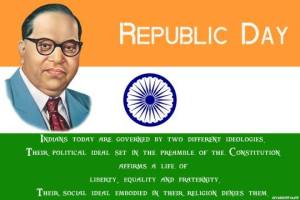
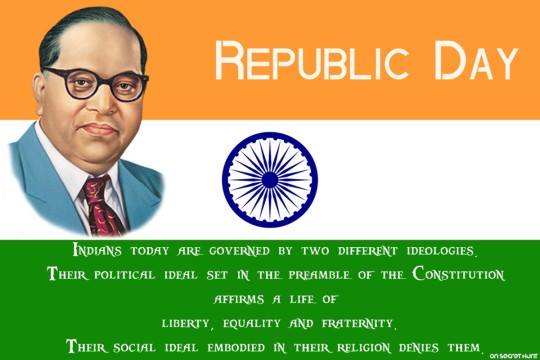
1011205_10151899927621479_1726212457_nThe University of Hyderabad is a University of Excellence in the Central University system and the prestige of the institution is of utmost importance. Our prestige comes from the character of the campus, the research atmosphere, our concerns for the environment and our contribution to the process of nation building. President Pranab Mukherjee put it eloquently:  On this day, sixty four years ago, in a remarkable display of idealism and courage, we the people of India gave to ourselves a sovereign democratic republic to secure all its citizens justice, liberty and equality. In this process, we should recall Ambedkar, the father of the Constitution, who nevertheless remarked that “Indians today are governed by two different ideologies. Their political ideal set in the preamble of the Constitution affirms a life of liberty, equality and fraternity. Their social ideal embodied in their religion denies them.”

Beyond religion, today there are many sources of denial of liberty, equality and fraternity. The Republic belongs to us all, but yet we have many groups who need inclusion. Across the country, people realize that many unheard and sometimes unseen sections of our society have to be included in the constitutional protection of the rights that are guaranteed to every citizen of the country. Thus the most important freedom that we need to remember on this day is the freedom from inequality. We have to guard ourselves against discrimination due to gender, sexual orientation, racial differences, regional and religious identities, physically differential abilities, in addition to class and caste. As people, we need vigilance against the threats of fundamentalism, of censorship, and in this election year, against all divisive politics.

The Constitution is the central instrument that will guarantee us our rights and freedoms. Long live our Republic! Jai Hind!
A stalwart passes on

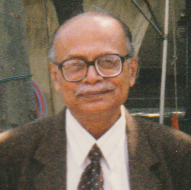
nagarajanThe University community is deeply saddened by the news the Professor S Nagarajan passed away on the 6th of January. He had retired from the service of the University quite some time ago in 1989, but for something like a dozen years he was one of the stalwarts of our Department of English. This is a great loss to the world of scholarship, and as Professor Narayana Chandran remarks,  “Nagarajan, the scholar and friend, will be missed by many here and abroad, [and] thousands of his students and colleagues will be deeply saddened by the news of his passing”.

Another colleague, Professor S Viswanathan adds “the fraternity of English teachers in particular and the academics in general and the community of scholars and critics worldwide have lost one of the remnants of stalwarts cast in the heroic and morally upright mode. He was a pioneer even as a relatively young person and much later in the latter phase of his career at the University of Hyderabad in setting up a research and postgraduate department. The Department of English and the School of Humanities owe a great deal to his presence in them as the leader.”

A brief biography of Professor Sankalapuram Nagarajan (1929 – 2014) has been provided by Prof. Narayana Chandran: He was educated at Mysore, Nagpur, and Harvard, began teaching English at an early age. His career started in Mysore (1948– 1953) but he later served the Government of Madhya Pradesh as Assistant Professor in colleges across the state (1953– 1961). The then-Madhya Pradesh government insisted that all its servants pass a basic literacy test in Hindi, a directive that caused him some hardship. Nagarajan was however happy to leave his job for a Fulbright Fellowship in the United States. This Fellowship, again, was hard-won, considering Nagarajan’s insistence that he would accept it on condition that he be permitted to work on a topic of his choice, viz., Shakespeare’s Problem Plays, an insistence the Fulbright Foundation found rather difficult to respect initially, given their commitment to promoting the study of American literature and culture in India. Nagarajan’s third appearance before the Foundation to explain his ideas on the Problem Plays not only won him the coveted Smith-Mundt-Fulbright Scholarship (1958– 60) and the Harvard University Fellowship (1959– 60) but strengthened his life-long commitment to the profession of English and American Studies in India, both specialties which he pioneered and propagated in at least two leading Indian Universities for more than three decades.

On his return from the US, Nagarajan joined Poona University Department of English (Reader, 1961– 64; Professor, 1964– 77). He founded a full-fledged postgraduate research Department of English at Poona and continued to be the ex officio Chair of the English Board of Studies until 1977 and coordinated the English-teaching activities of its affiliated centres and colleges for well over a decade. He was also the first Coordinator of Summer Intensive Courses for English teachers (that somewhat forerun the present Refresher Courses in the UGC Staff Colleges) for which he sought funding from the American and British cultural agencies in India. Among his other substantial contributions include the introduction of research in American, Indian-English, and Commonwealth Literatures and Critical Theory; and the addition of regular updated catalogues in the Humanities and cutting-edge books and journals to the Jayakar Library. Few colleagues in India know that the very first dissertation on an Indian English topic and the most influential first book on Indian English fiction were written under his supervision in Poona by Paul C. Verghese and Meenakshi Mukherjee respectively. C. D. Narasimhaiah of Mysore University and he were the founding directors of the American Studies Research Centre in Hyderabad (now called the Osmania University Centre for International Programmes).

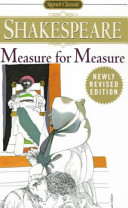
UntitledAmong his many academic honours Nagarajan prized most his Clare Hall Visiting Fellowship at Cambridge University (1987). The following year, Clare Hall elected him a Life Member, a rare honour because the membership was recommended by the Estate of Professor I. A. Richards whose special lectures Nagarajan had attended during the professor’s Harvard visit in the early 60’s. Other honours had preceded Clare Hall— the Fellowship of Folger Shakespeare Library, Washington D.C.; Leverhulme Fellowship at the Australian National University, Canberra; Staff Fellowship of the Association of Commonwealth Universities at the University of Edinburgh; and the National Fellowship of the UGC, India. An unusually incisive scholar and commentator, Nagarajan excelled in philological and interpretive scholarship, a sampling of which would include his masterful Signet Classic edition of Measure for Measure (1964; rev. 1990), and his essays and notes in such esteemed journals as Shakespeare Quarterly, Essays in Criticism, The Sewanee Review, Modern Fiction Studies, Comparative Literature, Journal of Commonwealth Literature, College English, Notes & Queries, ESQ, World Literature Today, The Arnoldian, etc. His papers have been widely cited and indexed in all the Humanities Indices and reviews of English scholarship across the world.

Long before English in India (its polemical history, traditions and practice) became a major subspecialty in English Studies, Nagarajan wrote and lectured on this subject through the late 70’s, beginning with his much-cited and controversial valedictory address at Poona University while relinquishing his Chair in 1979. That address became the draft of his “Decline of English in India: Some Historical Notes” (College English, 43. 7, 1981: 663–70) excerpts and versions of which later appeared in several Indian periodicals and magazines, and has ever since remained central to our arguments for and against its thesis. To have initiated, and sustained such a discussion for well over three decades, is no vanity. Nagarajan was writing at a time when English was being reconfigured as a language, discipline of thought, and an academic subject proffering supple confusions of commitment to its students in most postcolonial centres and English-speaking countries.

At the University of Hyderabad, Nagarajan left lasting imprint on a variety of academic and professional subjects such as administrative reforms, university governance, welfare schemes, library management, professional advancement and training bringing within its ambit the Campus School, and the departments and schools of study. The Humanities curricular reforms were always uppermost in his mind. So were matters pertaining to such fledgling centres (such as the CCL in 1989) which he helped build and nurture through his very last years in the University on a brief but productive stint as Professor Emeritus. Even during the most demanding days he had served as the Vice Chancellor of the University, Nagarajan was never known to have reneged on his teaching, missed crucial academic assignments such as giving lectures as the first UGC National Lecturer in English, Wilson Philological Lectures at Bombay, the Nag Memorial Lectures at Benares Hindu University, the Malegaonkar Lectures on Shakespeare at Poona besides sending quarterly reports and annual bibliographical input from India to the International Society of Shakespeare of which he was an honorary life-member.

Professor NagarajanIt was indeed a matter of deep regret for him (and huge disappointment for many scholars oriented towards bibliographical and textual criticism) that two of his cherished projects had to be abandoned either because of official apathy or unavailability of continued financial and logistical support on which much of his later work depended. The first was the incomplete Union Catalogue Project funded initially by the Government of India’s Ministry of Education and Culture. At least three years of unremitting hard work by way of coordinating, monitoring, and chasing published but fugitive books and monographs in English and American Literatures catalogued in the three Presidency Universities (Madras, Bombay, and Calcutta) yielded some bibliographically rich fascicles and files of correspondence but no complete, usable, and accessible record of material students could reliably consult from afar, the prime objective of the Project. The idea of the Project is believed to have tantalized Jadavpur and Delhi, comparably equipped Departments of English like ours, to take it up from where Nagarajan had left off, but few scholars today would dare to rush in there today, their e-knowhow and resources notwithstanding. The other Project that Nagarajan had to abandon on account of intermittent ill-health and poor connectivity was a systematic study of I. A. Richards’s unpublished papers deposited at Houghton Library, Harvard and Magdalene College, Cambridge. Here, again, Nagarajan had made some headway, but he was no longer the good old researcher, at once a hedgehog and a fox in the archives, a distinction among literary scholars the poet Archilochus was fond of drawing. He made notes in longhand, kept old filing cabinets and vertical files and wrote and rewrote his work, tirelessly and conscientiously. He mentioned the “intolerable wrestle with words and meanings”— his favourite passage from T. S. Eliot’s Four Quartets— that continued, “happily,” according to him, until the very last conversation I have had with him on phone. Few among the English teachers I have known used to keep their erasers in order as did Nagarajan.

booksTo conclude with Professor Viswanathan’s paean: What an impressive teacher he was! From a young age he was a contributor to top-ranking learned professional journals. His edition of Measure for Measure and the edition of King Lear he published speak volumes about his scholarship and acumen.

He walked tall in the field.

You talkin' to me?

Many years ago I managed to persuade a Romanian taxi driver in New York city  to let me drive his cab for a couple of blocks (I had helped him change a flat tyre, so I figure he was feeling kindly). It was strangely exhilarating, even if it was mainly along an empty stretch of a street in Harlem- the powerful brakes, the low centre of gravity, the idea of it all… But I digress.

nyc_taxiThat incident flashed through my mind (and de Niro fans will know why) some months ago when I saw the op-ed about Central University Vice Chancellors in The Hindu, Wanted: intellectual leaders, not CEOs by Apoorv Anand and Satish Deshpande of Delhi University. Trying to see it as a commentary on the system, and to not take it personally is even more of a challenge. Especially when the references seem so direct, and even though no names were mentioned. I guess if the shoe fits…

Anand and Deshpande start with a multiple choice question: Who or what is a Vice Chancellor today?

  1. The CEO of an academic corporation.
  2. An academic or bureaucrat with political connections.
  3. A person selected by accident, error or compromise.
  4. An intellectual leader.

but they don’t give a fifth (and more correct) choice, namely
5. Possibly all of the above, at least in bits and parts..

As Mark Twain said, those that respect the law and love sausage should watch neither being made. The same holds for the processes that bring about VCs in our country. Or any other position of some complexity for that matter.

There is a lot of what Anand and Deshpande say that one agrees with, and much that one can disagree with, even on purely academic terms. Boats are intrinsically sinkable, but only when they are on water, if there are leaks, and even then not always. So too, universities. If they have to function, there is always the danger that in some ways they will do so poorly.

With the two and a half years’ experience that I have had (and that has been more educational than some of my previous years in academe) it seems to me that some of the discomfort that is expressed is tied into the multiplicity of expectations that we have of our University system. It is not just a place where you get quality education that prepares you for jobs in the real world. Our Central universities are expected to play other roles as well. So is there a simple answer to the question “What is an Indian University for?” The multiplicity of goals that we, as a nation, seek to achieve through our educational institutions makes this a germane question, particularly as the answers themselves have evolved over the years.

Here is an incomplete answer: in addition to (tertiary) education, our universities are also sites of knowledge creation and knowledge preservation. They are arenas of skills development and vocational training. Being nationally funded, they need to assure wide and deep access, across geographical and social strata so as to be agents of social transformation, enabling social change. Helping people to cross barriers, both economic and social is one aim, but in addition, we also seek to make India a society with the sense of “scientific temper”. All this is done in the foreground of a globalizing (but still very feudal) society with a deep fissures and shallow pockets, so that there is a perpetual shortfall of public (or for that matter private) investment in what is very clearly both a public and a private good.

sailor-who-fell-from-grace-with-sea-mishima-yukio-paperback-cover-artAnd a VC’s job is to make all this happen smoothly while transforming the office itself in the same way as the country has been changing? In comparison, Rumpelstiltskin‘s skill seems a trivial one.

This post in not in defence of the indefensible. The slow and painstaking methods of intellectual leadership that Anand and Deshpande recognize as a requirement of being a successful VC is undeniable, but this is only one of the components… To focus on this- not that they are unaware of the other aspects- is to oversimplify the whole process. A complex system has complex demands, and to quote Mishima in closing, one is perpetually striving to make some sense out of the chaos of existence

The Second Law

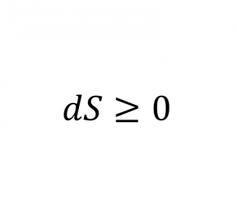
chaosThe Second Law of Thermodynamics, namely the general principle that the entropy of the universe increases, seems to apply to institutions as well as to the more restricted type of system it was first formulated for. The entropy is a measure of disorder in a system, so the second law may be reworded to say that the disorder in a system, in general, increases with time. (And conversely, this also helps to determine what is the ‘arrow of time‘ – the more disorder, almost inevitably the later in time.)

In recent weeks I have been thinking of the appropriateness of this concept outside the narrow realm of machines and engines where it was first developed. Going through some websites, I came across the following discussion, which asserts that “associated with the entropy production is the loss of ability to do work.” How valid, in general, though of course the context in which the statement was first made was quite different. And also, an “increase in overall disorder is therefore spontaneous. If the volume and energy of a system are constant, then every change to the system increases the entropy.” Change energy to UGC funding, and system to campus, and you can see that that statement still rings true!

imagesThe impending NAAC visit provides one focus for such thoughts. Although the campus has undergone quite a transformation, it has taken the concerted efforts of a large number of people, our NAAC team, the Engineering and Estate sections, among others, to bring back a semblance of orderliness on the campus. A huge amount of physical energy has gone into actually reducing the disorder on our campus- the repainted buildings are looking good, the roads are cleaner, the undergrowth has been cleared away- all in all, there is a freshness that is evident. Thanks to them all!

I don’t know what rating we will get since that depends not just on how we look but more on what we are, and the next few days will give us a chance to put forward our very best. But it is true that regardless of the NAAC visit outcome, it is getting increasingly difficult for the University to cope with the reduced funding and the consequent increase in entropy- be it on the matter of upkeep of our infrastructure, or the inability to meet the increasing demands of a larger and evolving community.

We have to look beyond the NAAC visit, even though it is very important that we take full cognizance of it. Occasions like this give us an opportunity to revisit if and why we are a University of Excellence, and what we really need to do to earn our spurs each day. In projecting the best in ourselves- and there is clearly a lot that is very good- we also recognize those parts that could be better, and indeed, should be better.

But in any case, whose University is it anyway?  It is ours, and it is pretty much up to us as to where we take it in the years to come. Any change that has to come has to come from within the system if it is to be lasting. That is, of course, one of the ways in which we might be able to fight the Second Law, but more importantly, that is the only way in which we can become the University that we want to be.

The year in review, and good wishes for the New Year!

The past year has had its ups and downs (more of one than the other it seems!) but it is good to end on an optimistic note, with the hope that the coming year will be better than the one slipping away… Here’s wishing all of us the very best for 2014!

WordPress made a report of this blog’s activity, and before I turn to other matters, here it is (and many thanks to them for the quick if somewhat impersonal and automated post):

Here’s an excerpt:

The concert hall at the Sydney Opera House holds 2,700 people. This blog was viewed about 26,000 times in 2013. If it were a concert at Sydney Opera House, it would take about 10 sold-out performances for that many people to see it.

Click here to see the complete report.

Some noteworthy events on our campus during 2013, starting with the inauguration of the School of Life Sciences building by Dr. M. Pallam Raju on January 3, the visit of  Joseph Stiglitz, also in January, the starting of a Kendriya Vidyalaya on our campus in April, the visit of Amartya Sen and Venki Ramakrishnan in quick succession in December, bringing the number of nobelists that came to our campus this year to three! Many of the faculty were recognized for their excellence, in teaching Prof. Kumaresan was named Teacher of the Year by the Indian National Science Academy, Dr Vaitheeswaran was given the B M Birla prize in physics, and Dr V Vakulabharanam the Amartya Sen award of the ICSSR. Many of the departments and Schools were recognized for their excellence by the UGC through the grant of special funds for research- all of which has made us one of the better endowed universities, at least funds-wise… There is more to tell, and much of it has been posted on the UoH Herald over the past year, or on earlier posts on this blog. Many awards, many distinguished visitors, many concerts, and many conferences, all evidence of an active and vibrant campus.

There were also some events that caused us much sadness, the loss of four students as well as some of our retired faculty and staff. And the progress of various projects on campus has been slow, particularly on the matter of constructions and infrastructure. The turbulence of the world outside has sometimes been reflected in events on the campus… I really hope that such things will change.

UntitledEvery new year deserves a resolution or two. We are now into our fortieth year, a special  anniversary of sorts.  Let us work to make the campus a better place, and our University the very best that we can be. Happy New Year!

Even better Khabar

imagesThe news that Prof. C N R Rao has been awarded the Bharat Ratna should be warmly welcomed in our University. After all he is one of ours, being conferred an honorary doctorate of the University in 2005. And importantly, he has been a mentor, directly or indirectly to many of our colleagues in various science faculties at the UoH.

a56c607e-c8fb-43ae-9c52-eaff0054b27eMediumResHe was on the faculty- one of the biggest stars of the stellar Department of Chemistry- at IIT Kanpur where I did my M. Sc. (Chemistry) in 1974. Actually, he was on the interview panel that selected me for admission in 1972 – no entrance exams then- and although I then did not know who he was, I can still remember one question he asked me then: How many molecules of water are there on earth? It was a serious enough question, and as I was grappling with estimating volumes, dividing by 18, multiplying by Avogadro’s constant and doing all that I could to come up with an answer, he added: When its not raining! 

I took Physical Chemistry from him the next year- he was an inspiring teacher in many ways- and over the years I have stayed in touch with him enough to be very very impressed by his tenacity and his passion for science. In Kanpur when he was already famous and had nucleated the Department of Chemistry, he was just about 40. That he has stayed current and obsessed with his science for the next four decades (and this shows no sign of abating) is phenomenal.

But the news of the Bharat Ratna to him is welcome in many many ways. It is, as he says, also a recognition of the value of science, of scholarship, of research. Having seen the institutions he has built, one could give it for that alone. And CNR does not mince his words- he is an outspoken advocate for research, and has let government after government know that funding for science is inadequate. As we all recognize only too well, funding for higher education is inadequate, and our only hope for excellence is that we get funded at reasonable levels. In the past two days alone, he has raised the sensibility of not just the political class, but indeed the public at large of the need for funds, for support. We need more champions like him.