Digital Colonizations

The internet has gradually thus assumed an epistemic role, one that does not just dominate the process of scholarship and knowledge creation today, but in many cases, determines its course.

59662I was dipping into Ryszard Kapuściński’s The Soccer War, struck again by the brilliance of the writing, the reporting of revolution and coups in the 1960’s onwards, as colony after colony tumbled, and independences were gained and regained. His insights retain their acuity well after the passage of so much time and little seems to have been lost in translation. In writing about Algeria, he says Colonialism fosters social chasms […] Colonial policy elevates a class of ‘cultured’ and ‘reliable’ natives while pushing the rest of society down on a stratum of poverty and ignorance. Different continents, different circumstances, but there is a familiar ring to it… And elsewhere, “… We knew exactly as much as they wanted us to know. Now it’s hard to change”.

Epistemic colonialism, the policy and practice of a power in extending control over others specifically in the sphere of knowledge, might well be the most insidious consequences of the different periods of colonialism that we have experienced. Our educational system is a consequence of this and is still Macaulayan in essence, retaining the imprint of our colonial history in its every aspect- the structures and bodies of all our universities, the subjects that are still taught, the degrees that we earn- all carry a mark of what and how much we were required to know. And it is proving very hard to change…

MTI3NTgyMzkzMDI3NTM3NTM5
A visualization of routing paths through a portion of the Internet. (Photo: The Opte Project/ Wikimedia Commons)

My concern in this post is in the evolution of epistemic colonization through the internet or more generally how the new media is used for its establishment, propagation, and growth. A catalyst for the growth of these concerns is the recent discussions, including the very public debate in our Parliament, that have made the issue of net neutrality, namely the principle that all Internet traffic should be treated equally, very relevant. The rhetoric, however, elides an important fact: the internet is intrinsically not a neutral space. In terms of value, or in terms of perceived value, the net is most certainly not neutral. And, in addition, not isotropic, at least not equal in all directions. This asymmetry plays an important role in the manner in which information is transmitted, and through that, the way in which knowledge moves around and is valued in the academic sphere.

Commentators have often pointed out that (as a body) we tend to respect knowledge and information that originates from or is validated by agencies that are located typically in the west. A consequence is that we also respect our own scholarship only when it is published and/or otherwise validated in the west and not in India. In fact, we even learn more willingly from sources that are western or that are trained in the west (an exception might be made for the notorious three-author kunjis that are required reading for passing university exams, but even they are usually poor copies of standard western texts).

The above issues have changed in the time of the internet through a process of digital colonization: spatial location is unimportant, historical connection is almost irrelevant, the immediate beneficiaries could well be unknown, and it happens faster than ever before. The colonization, such as it is, is complete- in all essential aspects- accelerating and exacerbating the already well-known issues of self-esteem that confronts academics in our country. What this does to our internal compasses- cultural, intellectual, or even moral- is a matter that should concern us, especially since the internet and social media is all pervasive and (for these times, at least) permanent.

Given that the preponderant language of internet discourse is English, and that the overwhelming majority of innovations in hardware or software occur typically in the west or (at the very least) in the global north, there are similarities to our historical past, but I should make it clear that this is not a rant against the evil west. For one thing, that is a bit dated anyhow, and we are, for better or worse, part of a global consciousness that counts both Plato and Einstein as one of “ours”, as much as we do Ramanujan or Kalidasa.

Image (courtesy Wikimedia Commons) of model neural connections.

However, the internet has become central to many of the fundamental ways in which we value or evaluate scholarship. If information is not available digitally, it is invisible. If meta-information is not available on a document, it is not just invisible, it is unimportant. Indeed, epistemic value is almost synonymous with how easily an object (or idea) is located by a popular search engine such as Google or whether it has its page on Wikipedia, or some similar measure of relevance.

Much of our scholarship in India therefore suffers from invisibility, most obviously when in languages other than English, but also work that appears in journals that may not have internet presence. The argument that the responsibility for this is ours cannot be countered, but the barriers that need to be crossed can sometimes seem very high, and are often growing higher. Wikipedia, for example, does come in many Indian languages, but many of the pages tend to be translations, and in any case, would be missed by most search engines.

The search engine is undeniably a major tool in contemporary research. Google, in particular, has changed so much of the way in which we retrieve information. Whether Google or any other, all search engines employ algorithms to search for information and display them in an order than depends on various criteria that include, among other things, the importance of each page as determined endogenously.  A piece of work, regardless of its intrinsic quality, is effectively invisible to the vast majority when it does not appear on the first two pages in response to a search query.

Over the past few years, many of the leading journals in the world have also gone digital- there are no print versions, so that accessing them is only possible via the internet. Many high quality journals (such as the Public Library of Science family) are born digital, and many of the older and highly prestigious journals have expanded, adding additional specialty offshoots that are purely digital (such as the various new members of the Nature family). This not only changes the way in which scholarly papers are read, namely online, but it also decides, indirectly, who reads them. Even though several of the new online journals are “open access” and there is a significant movement to support open access publications of scholarly articles, the fact that access to scholarship is only possible via the internet induces an inherent asymmetry. At the same time, the impetus to publish in online journals has increased. In part this is because getting into some of the more prestigious ones can ensure visibility, and in part, the proliferation of purely online journals has meant that more than ever before, there is a journal for each article.

Visibility matters, not just for the obvious reason that every scholar likes her or his work to be read, understood, and appreciated, but it matters for career progression and for reputation. Publications have always mattered for academic promotions, especially in higher education, and today, there are several metrics that help academic administrators decide a candidate’s worth: the number of citations, the h-index, the impact factors of journals, and so on. These indices eventually can substitute for the value of the scholarly contribution; getting published in a specific journal becomes the goal, regardless of whether the original research objectives might have been subverted in the process.

shacklesThe internet has gradually thus assumed an epistemic role, one that does not just dominate the process of scholarship and knowledge creation today, but in many cases, determines its course.  That this still manages to leave us intellectually colonised in world that is otherwise relentlessly globalizing is one consequence, of course, but it is a consequence that we accept, and more often than not, regrettably, one that we seem to expect.

Never in a modest mood

I could have easily written the first line, I have never seen Francis Crick in a modest mood, substituting any number of my Science Talent batchmates’ names for Crick’s.

Untitled 2Well before I read The Double Helix I could have just as easily written the first line, “I have never seen Francis Crick in a modest mood”, substituting any number of my Science Talent batchmates’ names  for Crick’s (myself included).  I first got to meet many of them in Jodhpur in the summer of 1970.

Today’s KVPY and INSPIRE programmes can proudly trace their origins to the National Science Talent Search Scheme (usually abbreviated to NSTS) that the NCERT initiated in 1963. The idea was to attract students to the pure sciences, and the version of it that was operational in the late 1960’s and early ’70’s, when I was in high school and in college was, in a word, great.

There was a certain simplicity to the NSTS. One wrote an exam (I remember doing that at the Government Arts College in Chennai), attended an  interview (mine was in Kolkata, probably at the ISI) and one had a project (and even then mine was more theoretical than practical), and if selected, all one had to do was to sign up for a pure science degree. Luckily that suited me just fine- I was not going to do medicine (no bio in my school) or engineering, and this gave me a way out.

Without exaggeration, getting the scholarship changed my life.  The NSTS gave one a monthly stipend, a book grant, and some tuition fees, but the real game-changer was the opportunity to attend Summer Schools every year up till the MSc degree!

The first was in Jodhpur… Four weeks, from the 11th of May to the 9th of June. Nearly 40 of us from all over the country landed up for one of the Chemistry summer camps (there were several others) in the University of Jodhpur’s Chemistry Department. At least half the group (see the group photo below)  was in the wrong place as it happened- some confusion, several mathematics undergraduates were mixed in the chemistry group-  but for many  of us, it was a refreshing change to the way things were at our home institutes (mine was Loyola College in Chennai). We had lectures in the morning, lab experiments in the afternoon. And a lot of one-upmanship virtually all the time.

jodhpurIt was a good summer. Hot, to say the least- it was Jodhpur after all, on the edge of the desert,  and my first experience of standing up after a lecture to find one’s anatomy embarrassingly outlined in sweat on one’s trousers…The lectures were mostly new material, the lab experiments too. I had decided I was going to do a project on organic synthesis, and spent much of my time making dyes- probably the last time I ever did any…

The teachers of the Department were a dedicated lot who did much to mentor us, but for the most part, it was mainly from one’s peers that we learned. To be honest I was more than a bit unprepared for the summer camp, coming as I did from the relative backwater of Madras University. We had just had a strike of sorts there, agitating for a more modern curriculum, and places like Delhi University and Bombay seemed just that much more mainstream. It was a time to catch up on what everyone else was doing, even if Shankar (who was clearly one of the smart ones) would preface every answer with some put-down (the mildest of which was that his kid sister knew better and in any case much more than you).

We also discussed the next big step: where to go for the MSc. There was little doubt in our minds that IIT Kanpur was the place to go, and from that batch, 4 of us actually did. Some others became very good friends, friends whose lives have followed parallel and occasionally intersecting tracks.  Lined up in that group photograph are at least two future Vice Chancellors, several Heads of Departments, some Senior Professors of well-known national institutions, and at least one CFO and one CEO.

UntitledAnd one partner in crime. The Mehrangarh fort dominates the Jodhpur landscape, and visiting it was essential, and something we did the first possible weekend we were there. A pile of rubble in the fort attracted the eyes of two of us, clearly some archaeological debris… Pretty soon another expedition (a mini raiding party, truth be told) was organized, this time we took along two satchels. I’m not sure anyone really cared, but we came away with little bits and pieces of history… A fragment of a trellis, a stone flower… These have stayed with us to this day, as has the excitement of the summer, the science, and the cameraderie.

This cameraderie of the science talent scholars was, I believe, one reason so many of us went on to make a career in science. (There is a very large fraction of NSTS Alumni in Indian academe, so by that token, the scheme was really very successful!) The example of one’s peers is too hard to ignore, and there was always someone to learn from, and the more they made you aware of it, the more there was to gain. I very quickly realized that Bombay University’s BSc syllabus was way better than ours, so I got a copy and studied from that far more diligently than I attended classes in Loyola…

Pakeezah 2I missed the next camp that was held in Roorkee, but made it to Chandigarh which was another memorable summer but (owing to some indiscipline on our part, I think) it was not quite the full four weeks.  That summer was dominated by the movie Pakeezah, and we heard the songs so often on the Panjab University campus, that to this day they remind me most of the rajma-chawal in the hostel in the summer of 1972, with another set of science talent friends.  Some had been there in Jodhpur and many who had missed that camp but who had gone to Roorkee. For all of us this was also the last such camp since we had all finished our BSc examinations- and even for those who were going on to the MSc the summer camps would all be individual laboratory placements. The discussions of what next, what research fields to pursue, where to go… all these dominated our evenings.

This is something to think about, especially given that every year now there are almost 2000 students who participate in the Inter-Academy Summer programme. The way it works now is that students go to individual laboratories for six weeks or more during their summer vacations. The research opportunity is good, but each student is (by and large) isolated- there is no community being built. It would not take too much effort to do this, given the fact that there are large numbers of students at some places like the IISc, Bangalore or the University of Hyderabad. A few lectures together, some evening programmes, some opportunities for them all to be in a less than modest mood… maybe there would be something to it.


The Matter of Degrees

Many changes need to be made urgently to the pattern of higher education, to rationalize the degrees and to ensure that university education is of value. A new and modern Education Commission is essential to bring these changes about.

dissertationboost

We have not wings, we cannot soar;
      But we have feet to scale and climb
By slow degrees, by more and more,
      The cloudy summits of our time.

When it comes to Indian universities and the degrees they give, where should the discussion even begin?

To be sure our Universities are about learning and teaching, but equally important is certification. Indeed, one would not be blamed if one thought that for the most part, the main aim of our Universities seems to be to hold examinations and then award (or deny) degrees. At the (somewhat limited, I now realize) universities I have taught at, the degrees were few: Ph D, MA, MSc, M Phil, M Tech, MPH, MCA, MBA, MFA, BSc. Maybe a few more. I don’t know if there is this level of bureaucracy in other countries, but the link on the UGC website of the list  of recognized degrees is instructional. (As is their list of Fake Universities, but that is grist for another post!)

UntitledAs a matter of fact there are more than 160 different types of degrees (and many many more if one includes the varied flavours of specializations) that are awarded by our 700 Universities. Some of the nomenclature is  fascinating and revealing of the deep love of minutiae that our academic administrators have.  The 3 year degrees BHM (Bachelor of Hotel Management) or BHMTT (Bachelor of Hotel Management, Travel and Tourism) is distinct from the 4 year BHTM (Bachelor of Hotel and Tourism Management), for instance. And one can even earn the MHRD, the Masters in Human Resource Development in 2 years, but it can take 4 for the Masters in Optometry.

There is a serious need to rethink much of this. Love of diversity apart, there is no reason to have such a set of whimsical and distinct degrees. For one, there is inconsistency in the durations.  Bachelors degrees can take 5 years (e.g. Planning), 4 years (BMM, Bachelor of MultiMedia, Bachelor of Clinical Optometry, or the BHTM mentioned above), 3 years (the bulk of them, BA, BSc, BCom, etc.), or even 2, as the newly restructured Bachelor of Education will be. Masters level degrees are even more of a zoo- while most do take 2 years like the MA, MSc, or MCom, there are the 3 year MSc Tech. degrees and the 4 year Master of Optometry, MO.

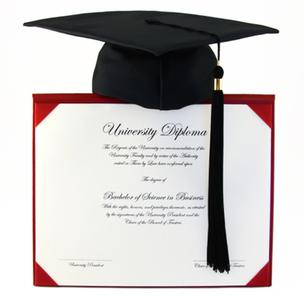
UniversityDiploma*304Careers should have primacy when these degrees are being thought about- quite frankly most of us do not have the luxury of doing degrees that do not lead to a real qualification, namely something that makes a real eligibility for a job. The degrees that lead to nothing except the next degree are the worst offenders, and of these, the M. Phil. is by far the least enabling. Once upon a time (and it does seem like a fairy-tale)  the M. Phil. had consequence and meaning, but today, for the most part, it is not much more than “time-pass”. There is no job that requires an M. Phil. and nothing more, and the only thing the M. Phil. makes one eligible for is the Ph. D. But admission to the Ph. D. does not need the M. Phil., making it a sufficient but quite unnecessary degree…

There are other degrees in fringe subjects given by mainstream (or any) universities. Can one still get a degree in Oriental Learning? Who does, and where? Is there really such a thing as a Ph. D. in Astrology? What would the point be? It is telling that the bulk of these unusual subjects get taught in one or the other of the “Deemed-to-be” Universities, but there are still many, like the Bachelor of Homoeopathic Medicine and Surgery or BHMS, for instance that is taught at at least one major central university and many state universities. Homoeopathic Medicine is bad enough, but Homoeopathic Surgery? And a Bachelor of Technology in the Humanities? Really?

These degrees sound like subtle ways of trapping the gullible. What jobs are the holders of such degrees entitled to at this time? This is something that the MHRD and the UGC need to seriously think about. But more, why should it take a minimum of 8 years to become an Masters level qualified optometrist, and only 5 for an MBA or an MBBS? And 4 to be a qualified Engineer, or 6 if one wants an M. Tech.? And why should anyone who wants to be a schoolteacher have to now spend 5 years (three years for BA/BSc/BCom + the two year BEd) when earlier it was 4? Rather than number of years, it would seem better to ensure that the person is properly qualified through a reliable certification.

Caveat emptor, Latin for let the buyer beware.In a more responsible setting, university degrees should not need to carry a warning label or a “best before date”. But reputations take a while to grow, and the public at large need not always be vigilant. I have had close friends fall victim to spectacularly fraudulent instances like that of the Rai University that finally hit the newspapers, but there are scores of other examples of degrees that have little or no value and institutions that advertise extensively have a way of attracting clientele who find out much too late if at all. There is something to the plea of the Minister for HRD that they should be allowed to close down institutions that are of poor quality.

As I remarked in an earlier post, there is nothing very Indian about our Universities, so adopting some of the practices of others might serve us well. Especially since those practices come after a sufficiently long period of incubation and evolution. One practice that needs to become more widespread is to focus more on outcomes (rather than what the certificates say) by having an independent qualifier. Even our much vaunted technical education is wanting in this regard: just three years ago, 83% of our engineers were found through a survey to be “unfit for employment“, unfit in communication skills, confidence, presentation, problem-solving capabilities and generic abilities. And who can guarantee that holders of other degrees are not similarly wanting, especially when there is no attention being paid to the effectiveness of either the teaching or the learning.

There is an argument that for most Indians, entering the workforce earlier is preferable. By age 24 rather than 25 or older. And given that school leaving is at 18 for the bulk, it would make sense to keep outcomes in mind rather than just the degrees and their historical antecedents. There would be some merit, therefore, in merging, as far as possible and across the board, bachelors and masters degrees and shortening the overall duration, while ensuring that the training quality is independently assessed.

In the past few years, there has been some public debate on these issues, largely as a consequence of Delhi University’s decision to first introduce and then withdraw a four year undergraduate program, the FYUP. Given the fact that the bulk of the undergrad programmes in DU were for 3 years and many of these had related Master’s level courses for 2 years, shifting from a 3+2 scheme to a 4+2 scheme put in an additional strain on the infrastructure, not to mention an additional financial burden on students. Making the Masters just 1 year after the 4 year undergraduate degree was unacceptable to even DU dons, and in any case it would kill movement between Universities. The obvious solution, which is to make the Masters redundant by merger of the bachelor and the master degrees was not even considered. This would have been truly innovative and would have been widely supported if done properly.

Whims, as a Professor of History from DU wrote in a recent op-ed in The Hindu,  be they of vice chancellors, or of teachers, or, as was true in this particular case, one mandarin and his minister, should not rule the fate of university education. The running thread of irony apart, there is much to agree with in the editorial, but the suggestion that “it is time that an Education Commission consisting of experienced and respected academics and educationists was set up to take stock of the state of our universities and to seriously deliberate on what needs to be done to improve the quality of education that they impart” is too little, although not too late.

The higher education landscape is changing faster than ever, what with widespread access to the internet, MOOCs and so on. Degrees may well become redundant soon- when students can learn specific subjects on the net, and from teachers across the world. Whether these offer solutions to us or not, the present policies of higher education do not appear to recognise the existing realities, or for that matter, to respect them.

Many changes need to be made urgently to the pattern of higher education, to rationalize the degrees and to ensure that university education is of value. A new and modern Education Commission is essential to bring these changes about.

The verse quoted at the beginning of this post is from The Ladder of St Augustine by Longfellow (an additional benefit of my Catholic schooling). In closing, the poem’s final stanza is apposite:

Nor deem the irrevocable Past
      As wholly wasted, wholly vain,
If, rising on its wrecks, at last
      To something nobler we attain.

What are Indian Universities for?

0_157de7_593f1191_origThe recent (and ongoing) discussion on the irrelevance of the UGC, the University Grants Commission of India, and fears of what might well happen to higher education in the country in the wake of the Hari Gautam Committee report brought this question to mind yet again. And coincidentally, a recent issue of The Economist is all about University education, although the take there is that too many people across the world are aspiring for a university education, and they (The Economist, that is) worry that this may not necessarily be a good thing. (Which leads to my knee-jerk reaction that in that case it surely must be!)

Experiences at the University of Hyderabad apart, I have had this concern for a longer time, at least since I came across Stefan Collini’s What are Universities for?, an extremely thought provoking book, more germane to our situation than the formidable The Great American University by Jonathan Cole, both of which are probably required reading for any academic administrator. Probably also for any academic, at the very least to provoke cogitation along the trammelled path of “why are we here and where are we going?”.

The basic question can be phrased in many ways… What(ever) are Indian Universities for? What are Indian Universities for? What are Indian Universities for? In any case, there is nothing particularly Indian about our universities- they are for the most part, imitations of a very western model and are by now some mix of the English, European and American university ideal. What they are for, ostensibly, is also clear- education of our youth. But just how they do this, what they do in the process, and how effective they are- these are all issues that need an extended discussion.

To begin, some background. There are something like 700 institutions that are classified as universities in India. Some are Central, some are State, some are Private, some are Deemed. (The last category inspires the not so tongue-in-cheek remark by a now retired Professor at an IIT, that if some are deemed, then there are others where the education is dumbed down, their future is dimmed, and in general they are all damned and in the end, all these institutions are doomed.)

Regardless of the classification all are regulated, and some quite strictly, by the UGC. One could argue that without governmental intervention, all of education would be at the mercy of the market, but it is clear that in the sixty plus years that the UGC has been in existence, its role and status has dwindled to the extent that neither does one have respect for the institution as a setter of standards or as a watchdog for quality in education. And yet, because of the way in which governmental funding is channeled through the UGC, almost all Central and most State Universities have to pay obeisance at its portals. And because of its regulatory role, all others- the private and the deemed- must similarly fall in line as well.

But there are other guardians of quality. All professional degrees are, for instance, regulated by specific bodies. The AICTE for all technical education, including business management, the Bar Council for law, the MCI for medical education, not to be confused with the INC for Nursing, and so on. I counted them once and tallied about 17 in all, and finally understood why we really don’t have comprehensive universities in the country. It is simply impossible to be answerable to so many regulatory authorities, especially since each of them in one way or the other prides themselves in being statutory bodies with the responsibility of establishing and maintaining high standards of […] education and recognition of […] qualifications in India. It registers […] to practice in India, in order to protect and promote the […] of the public by ensuring proper standards in the practice of […]. (This manifesto is taken from the MCI and made subject neutral-one can fill in the […] by appropriate nouns and adjectives.)

Oftentimes these regulators can be in conflict with each other as well. Their intentions are noble and important- any profession is valued only when there is certification, but the background against which these councils operate in our country is one where standards and safeguards are flouted with impunity- not to mention extortionate fees for some subjects, inadequate levels of teaching and often a complete disregard for quality, and so on. But when a council requires that teachers of its accredited institutions should be fingerprinted- however necessary that might seem- one gets the feeling that one has reached a nadir of some sort as far as education management is concerned.

The idea that the proof of the pudding should be in the eating is, regrettably, not that widespread. Looking at outcomes is not that common in our country- more attention is given to getting into the system than looking at what comes out. One’s JEE rank is finally quite a bit more important the grades one might have earned at the IIT, or for that matter how good an engineer one actually is. (One has to eavesdrop on any conversation among IIT graduates to realize the truth of that…)

There are exceptions, most notable among them being ISB, the Indian School of Business. A strong desire to not be subject to such regulation, without necessarily being unaware of quality or standards has made the ISB shun a formal degree (which would have brought them under either the UGC or any one of the 16 other councils or commissions that regulate higher education in India). The value of what students are taught there, as well as the high costs involved have together made the ISB a brand (and an expanding one, at that) to reckon with, one that competes with and often surpasses the IIMs. (Caveat: The ISB example cannot apply to many areas of study and is therefore singular, and there are flaws in that model as well, being accessible to a vanishingly small fraction of the population.)

To my mind there still is a lesson here. For the most part, the purpose of education at this time is employment, and degree or no degree, if that objective is served, this is a measure of the success of the system, howsoever limited that might be.

nalandaBut there is a much more important part to education, the part that helps create a scholarly ethos. It is that as a society we need a place where one can discover, invent, archive, catalogue, train, explore, think- in short, a place where we can do all the things that are possible at a modern university. There are more uses of the university life, but above all, it is one place where we can invest in our futures in a somewhat abstract way and very consciously for the long run.

The question in the title invites a more extensive exploration, one that will occupy subsequent posts in this blog. The future of the Indian higher education system is something that concerns us all very deeply, and its future is inextricably linked with our future as a nation and as a people.

The Mother of All Chemistry Departments

There is a very real Masonry of IIT-K Chem alums: strong ties bind us to where it all began. For all of us- teachers and students alike- this was a great initial condition to have.

snake1972 was a very good year to join the IIT Kanpur Chemistry Department as an MSc student. Some 15 of us, bright eyed and bushy-tailed for the most part, did. There was an incredible air of modernity about the place, from the architecture, to the teachers, their teaching, the labs, the hostels, the facilities. The passing years have coloured the memories and blurred some of the edges, but nevertheless, I can still remember the freshness of the campus and the feeling that we had arrived somewhere special.

Most of us- barring the Delhi University sophisticates- were from colleges in somewhat provincial universities. And in those days, universities in Madras, Kolkata, Pune and Bombay all were to varying degrees provincial, and we had classmates from Madurai, Kolhapur and Burdwan as well… All plagued by poor and outdated syllabi, bad teaching, the works. Many of us were also scholarship holders of the National Science Talent Scheme, that great initiative of the NCERT, and we had been exposed to some of the more modern ideas, so we knew the good places to go to. And without doubt, IIT-K was the place to go to if you wanted to do chemistry, with the added attraction that if one did reasonably well, it was a direct line thereafter to the US aka “Fatherland”.

The Chemistry Department, to put it mildly, was rocking! Our teachers were (and many still are) legendary. Almost from day one, the classes were in a completely different category from what we had been used to- no notes for one thing, surprise quizzes, open book examinations… It was not unusual to get homework from the latest issue of JACS, the Journal of the American Chemical Society- giving us the feeling that this was what an international education was all about. And it was.

Arguably, the Chemistry Department at IITK in those years was competitive with the best in the US. The faculty line-up was exceptional and the publication standards were better than most. All the big names were there- and let me not name them, the faculty at that time was the who’s who of Indian chemistry. But more than being famous, they were really inspirational. I can still recall- almost verbatim- a course in Group Theory that we all took in the second or third semester (another innovation in 1972!). And the course in Synthetic Organic Chem. or that in Phys. Chem… The geeks amongst us (mostly all) had it good.

It was a time, the first that I remember, when I was immersed in a group that, by and large, loved a subject. We talked chemistry, did homework together, did projects (some crazier than others). My undergraduate years had been spent largely in goofing off- most of those who came to the BSc course were there to pick up a degree and move on to the rest of their life- IAS, MBA, whatever- and the few who were interested in the life academic were oddities.

173_001Peer group pressure (and there was plenty of it!)  and teachers apart, there was a steadily growing set of seniors that were setting standards. The ones who had gotten into Harvard, or Chicago, or wherever. The ones who had written research papers as MSc students (and in Nature, no less). The ones who were clearly going to be the next big things… This made us, for the most part, academically very ambitious. In the days before rankings had reduced everything to labels like top ten and so on, there was mostly reputation to go by, and when we applied, the bar was always set high. A few in our class decided not to go on with a Ph D in chemistry- IIM Ahmedabad and BARC were the alternate choices, but for the rest, the next step was to Harvard, Princeton, Berkeley, Chicago, Indiana, SUNY, and so on. But in 1973 the level of competition that one sees today was just not there; all it took to make an application was a respectable GRE score and an aerogramme…

FB_IMG_1425833106934 copy
Prodipto Banerjea (note the deadpan expression) and I in a friend’s hostel room in Hall V, IITK. Early 1973, given our attire and the cut-outs on the wall.

This post actually started out as a long answer to a short question by one of my students as to what “were your thoughts then?  On aspects of academic/extra-academic life… I mean, how did you see the world that time?”. Truth be told, the thoughts were all in the short term. Very short term (as the pictures on the hostel room wall might suggest). Competition was strong, so one wanted to be at a local maximum at the very least, but one could also see what the milieu was throwing up. The B. Tech. batches were very gifted and this was before the coaching classes had dulled the sheen of the JEE rankings. The talents were visible and aplenty, with enough 10. someones, as well as the clearly very cool set.  The faculty was very liberal- in some ways more than what we see now: I recall, as an MSc Chemistry student, taking MSc and Ph D courses in the Physics Department, for credit. Not too many questions asked, and it figures on my transcript. (At the two Universities where I have taught recently, I can say with certainty that if this happened at all, it happened with much sturm und drang.)

And our teachers experimented with pedagogy. With a lot of thought, as even a casual look at the course curriculum would tell- it is, even now, a surprisingly modern curriculum. And with an ability to change. Willingly, as some teachers introduced Bio into Chem (it was not that common then) and unwillingly, as when some of us trashed the attendance requirement and told the instructor we would only do tutorials and the final exam, not go to his classes.

There was a downside, of course. We did not share a certain kind of easy friendship that a less competitive atmosphere might have engendered. Of my 14 classmates, I have not met 4 in the last 40 years, and only 4 of them more than once or twice in all that time. Five of our class chose careers outside science, four were in industry, one went to a national laboratory. Academics eventually attracted only five of us, two in India and three in the US, making the connections more and more tenuous with the passage of time. And now most of us are reaching retirement, so in retrospect, and there is only retrospect now, this was a major shortcoming. A sense of community certainly helps beyond the science, and grass being greener apart, I think that other groups of the same times have bonded better. Maybe it was that we were only together for two years- not a long time, admittedly- but still.

17235.iconBut there was more, much more to IIT K than just the classes, and enough attention to these aspects had been given when the institute was set up. Extracurricular activities apart, there was an airstrip, and a TV station as well- that actually broadcast programs on campus, including the 1973 England vs. India test match that was played in Kanpur, Gavaskar and Bedi being the stars then. And as for the airstrip, I’ve forgotten the chap’s name, but his nickname was Pilot because he knew flying, and I- in retrospect foolhardily- went up with him in a glider. Given the level of safety that we all subscribed to, its a miracle that there were no major accidents! (I would do it again gladly, of course.)

But to get back to the title of this post, the IIT-K Chemistry department was, in many ways, the progenitor of many others that were set up in the 70’s both in style and in content. Many of those who taught us were to leave shortly thereafter to take up positions in Hyderabad, Kolkata, Bangalore and elsewhere. In a sense, the research and teaching culture spread, and flourished.

There is a very real Masonry of IIT-K Chem alums: strong ties bind us to where it all began. For all of us- teachers and students alike- this was a great initial condition to have.

No goodbyes

indexTwo friends of mine died very suddenly, or at least the news of their passing hit me abruptly, and in a way that has made it impossible to say goodbye. Time, distance, but mostly the tenuousness of the connections in addition to the transience of being…

Two days ago, Meera Kosambi died. A newspaper reported (I have made very minor editorial changes) that “Noted sociologist Meera Kosambi, the younger daughter of the great historian and mathematician D. D. Kosambi, passed away at a private hospital in Pune on Thursday after a brief illness. She was 75.

Ms. Kosambi, who did not marry, had an illustrious pedigree. Her father, a polymath, was India’s pre-eminent Marxist historian, while her grandfather was the renowned Buddhist scholar and Pali language expert, Acharya Dharmananda Damodar Kosambi.

Ms. Kosambi did her Ph.D. in sociology from the University of Stockholm. She wrote, co-wrote or edited more than 15 books which reflected a lifelong preoccupation and passion for the notion of the modern, emancipated Indian woman. While all her works are shot through with brilliant and incisive scholarship, Ms. Kosambi’s crowning achievement was to turn the light on Pandita Ramambai, the great 19th century Indian reformer and educationist and early pioneer of women’s emancipation in India.

MK-GiraffeThrough her splendid translations of Returning the American Gaze: Pandita Ramabai’s The people of the United States (1889) and a volume of Ramabai’s Selected Works, Ms. Kosambi was instrumental in salvaging the great reformer’s reputation from the debris of time and restoring Pandita Ramabai to the pedestal of one of Modern India’s most illustrious figures. A wide-ranging writer and intellectual, she authored numerous essays and books on topics ranging from Marathi theatre to the social ecology of Mumbai.”

I got to know Meeratai- and she insisted that I call her that- in course of my attempts to reconstruct the D D Kosambi mathematical oeuvre about five years ago. Introduced on email by Romila Thapar, I addressed her once as Meera, inviting her immediate reprimand. Subsequently, after many meetings in many cities, including a memorable lunch at Malaka Spice in Koregaon Park in Pune, and a unexpected visit of hers to the University of Hyderabad, I got to know some of the many personae of Meera Kosambi.

There is much I am grateful to Meeratai for. The opportunity to rifle through a big box containing some of DDK’s papers, the many anecdotes of her father and grandfather, sharing her ongoing work, the books she was writing and so much more. (The papers have been digitized and the originals are now kept in the NMML.) Once when I was telling her I was planning to visit the Kelkar Museum in Pune, she told me to look out for Anandibai Joshee’s quilt– something I would have missed for sure. There was a book she was planning on Anandibai, to set the record right on the person she really was. Although this will now not happen, there is some small consolation that Meeratai did help with the chapter on Anandibai in The Girl’s Guide to a life in Science.

I’m particularly glad that I was able to show her the essays I had written on her father’s mathematical contributions. She admired these (the fundamental and important contributions, that is) greatly without being able to understand much (or any) of the mathematics, and over many conversations I tried to explain some of it. I’m not sure that it got through, but I was very pleased that she included one of the essays in her book “Unsettling the Past: Unknown Aspects of D D Kosambi”. She was to have come to Delhi last year when I spoke at the Nehru Memorial Museum on Kosambi’s mathematics, but a minor illness made it difficult for her to travel then. A month or so later I saw her briefly, the last time.

In the end, her final illness drew a very abrupt curtain- no time for goodbyes, or even to thank her for her exceptional generosity. And given that she was the last of the Kosambis, there is nobody but other friends to reach out to, but it is not enough…


The abruptness of Meeratai’s passing reminded me again of Esther Liberman, a friend of many years who I first met when she came to India in the early 1970’s on a summer trip for social science teachers. She was a schoolteacher in a private school in New York. I kept the connection when I was a graduate student in Princeton- and during many visits over many weekends when I got to know her better, and her husband Gil and her beloved dachshund… Esther and Gil lived in a great apartment on Riverside Drive in New York, were archetypically liberal and opinionated, and were great for a discussion on just about anything, from (in those days) Ronald Regan‘s presidency to Disco Sally (both whom they reviled). When George Bush became President she declared her intention to retire in India and I believe she was even half serious about it- by that time she had gained a lot of friends here on many visits.

indexOne Sunday afternoon in 1998 or thereabouts the both of them were killed in a freak car accident. Esther died on the spot and Gil a few days later, a speeding car coming the opposite direction jumped the divider and had banged into them. I heard about it a few days later, and by that time it was truly all over. They had no children, no surviving relatives, and since they lived in another world, there was nobody to share the sorrow of their passing with. For many years thereafter I felt unable to even visit New York, my sense of the city was so tied up with Esther and the many shared experiences. Lunch at Chanterelle. A visit to Sloan-Kettering when Gil was operated for oral cancer. The Met. MOMA. A visit to see her aged mother in a nursing home. Schindler’s Ark. A walk in Central Park…

There was so much more. Esther was the first to tell me about the small world phenomenon, the six-degrees-of-separation in a characteristically Esther way,  “Ram, there are only 800 people in the world!”.  The mathematical model, which came some years later, basically amplified this idea, that we each tend to know about a thousand people, so with a world population of a few billion, it takes no more than six links to connect any two people. But in the end, even the links were not that many.

The last time we met with Esther was at the Railway Hotel in Puri, eating jam roly-poly. And a few months later, she was gone, and I have had no occasion to grieve, nothing to mark the passing of a dear friend except for an empty feeling that there should be something more than just this.

fin_einde

Letting go

In the end it was both difficult and not very difficult to bid farewell to the UoH chapter of my life.

TrLPWuisms apart, it will always be an integral component of my academic career, and as I said at a small function at the DST auditorium on campus a few days ago, I truly value the various opportunities that I have had to try out some ideas in academic administration, to try out some ideas in academic management, and the opportunities to try something different. Of course, given the sizes of the relative entities, getting an organization as large as a forty year old University to budge is much more difficult than to make the corresponding move oneself. Also given the fact that my personal motto is not (even if it does occasionally seem that way) “As my whimsy takes me“, I found it easier to adapt and change. And of course, change I did. The avoirdupois part is visible enough, as is the difference between the before and after photographs of my receding hairline, but the real changes are hidden elsewhere.

250px-Symphony_No._8_in_B_minorWhen writing to a colleague, I chose to call this segment of my life Schubertian. Not so much in the vision romantic or grand, but to echo the alternate title of his Symphony No. 8, The Unfinished. In the mid 1960’s there was also the wonderful(ly funny!) P D Q Bach’s take on Schubert in his Unbegun Symphony. In the days before the internet, the staples of graduate student evenings included Richard Schickele, Monty Python’s Traveling Circus and Tom Lehrer, but these have all not aged nearly as well as one’s memories of them… So some of it nods to the unbegun, and some of it to the unfinished. But this is not a time to take stock, and time alone will tell.

I was most apprehensive that the emotion of the moment would be too much- I am bad at goodbyes, and unrelated memories often have a way of intruding inappropriately, but in the end, I was glad that it all turned out to be fairly matter of fact. People spoke, I like to think factually, and said some nice things. And there were some who did not, but not in the way of the AIB roast (I wish!) or other such, but some irrelevant and very tangential remarks. But the moments pass. And in the end the drama of the last few minutes made it much easier to let go, what with the florid display of emotion over a matter that was, again, irrelevant to the moment. And again, the moments pass. I don’t particularly hold these instances to be characteristic of the UoH. There were enough messages that I got that were more in keeping with the ethos of the University and the values that we hold dear. Or having seen so many of these displays over the past several months, perhaps I should say that there are values that we should hold dear… One cannot but help noticing that as the national mood swings to a state where there is zero tolerance for petty corruption, the local expression of support that evening was for an act of simple and outright fraud. But let the courts decide that.

IMG_1138One of the more difficult things about letting go is that one returns to a life less variegated, a more monotone existence where the mornings pass into afternoons and evenings of a sameness. Having worn the trappings of office somewhat lightly, or so I thought, I felt that it would be simple to be back in my office at the JNU. But… the diverse nature of a typical working day at the UoH cannot be matched by the texture of my typical working days at JNU, given that I’m not even teaching this semester. Its far too early to tell whether it is just that I miss the bustle of it all. These initial moments are all too self-conscious…

Anyhow, what I hope to do on this blog is to write on stuff that I care about. Mostly education related, I suppose, but also other things. Travel maybe. My blog of the past three plus years was too focused on matters central to the UoH, so its time to let that go. And simply to move on.

Closure

We need to think more seriously about where we are, where we want to be, and just how to get there.

One could not have asked for a more satisfying closure to my time at the University of Hyderabad. The day I left the University, there was the following press release from Rashtrapati Bhavan:


UNIVERSITY OF HYDERABAD WINS

VISITOR’S AWARD FOR BEST UNIVERSITY

rashtrapati-bhavan-imageThe President of India, Shri Pranab Mukherjee will present Visitor’s Awards for Central Universities in the categories of ‘Best University’, ‘Innovation’ and ‘Research’ for the year 2015 at a function to be held at Rashtrapati Bhavan on February 4, 2015. This function will coincide with the third Conference of Vice Chancellors of Central Universities scheduled to be held from February 4-5, 2015.

The Visitor’s Award for the Best University will be awarded to University of Hyderabad.

The President had announced institution of these awards at the Vice Chancellors’ Conference last year with the aim of promoting healthy competition amongst Central Universities and motivating them to adopt best practices from across the world.

Rashtrapati Bhavan : 29.01.2015, 15:20 hrs


It’s really nice that we (since I do continue as Honorary Professor in the School of Chemistry as well as in the Department of Biotechnology and Bioinformatics at the UoH, I guess I am entitled to say we!) have been given the award in the very first year it was instituted.

There are two other Visitor’s Awards, for Innovation and for Research, and as the press release points out carefully, The Best University will receive a Citation and Trophy while winners of the Visitors’ Award for Innovation and Research will receive a Citation and cash award of Rs. 1 lakh. I think that’s just as well; while some money would have been nice, the honour is in fact greater. Let’s hope that this will translate into more recognition later.

Over the past three years the President has been emphasizing the need for quantitative markers of excellence, indicators that goes beyond just reputation. While that is in fact important, I am not sure that getting into world rankings such as the QS or THE lists really serves us well at this stage of development of our University system. Within India we have the NAAC, but that has its own constraints. In any case the ranking agencies outside India do it for a range of reasons, some of which are tied into the manner of funding of universities, both public and private. I suspect there is virtually no system of ranking that is foolproof, and most of the time, criteria can be tweaked very effectively as any examination of ranks between 10 and 100 will reveal.

While the Visitor’s Award is for performance within a small group of Central Universities, it is nevertheless one way to spur us on to do even better, and to think more seriously about where we are, where we want to be, and just how to get there. No poetry quotes this time, we’ll get there only by some fairly hard work…

The Last Post

Yaksha (from Wikimedia)

In that great book of ours, the Mahabharata, one chapter I find worth reading and rereading is that of the Aranya Parva, which has to do with the Yaksha, and his many questions. (The idea of an examination where the consequences of failure are dire is an interesting one, and the resemblance to a vice-chancellorship is quite unmistakeable.) In the final parts, the Yaksha asks, “What is most wonderful?”, and Yudhishthira (who by then is the only survivor) answers,“… Day after day, countless creatures go to the abode of Yama, yet those that remain behind believe themselves to be immortal. What can be more wonderful than this?

A Vice Chancellor is appointed at the University for a five year term. I came here on the 1st of June 2011, and so should have stayed until the 31st May, 2016. However, that is not to be. I shall be leaving somewhat sooner than that.

The reasons for this early departure from the position are purely personal, and I appreciate all those who will respect and protect my privacy on this count. While some aspects of why I wish to leave are known to some, the interpolations and extrapolations are many, all of them incomplete and in the end, all probably incorrect as well.

As my term at the UoH draws to a close, it is impossible to not try to take stock, and also impossible to not make a wish list of what still needs to be done, the miles to go… Difficult though it is, I shall do neither. Three years and a half is not a short time, but it is also not long, and I am sorry to leave when so much that I had in mind remains unfinished. There’s really not much point making any evaluation on such timescales- as I have said earlier on these pages, the race is not always to the swift.

9465_10203253875651642_6606008948002324217_nI have valued my time at the University and am grateful for the great opportunities that it has provided me. In particular, for the chance to take the road less traveled by. The UoH has completed forty years in 2014, so one is also reasonably secure that ours is a robust system, one that has weathered many storms and one that is strong in its foundations. I am therefore confident that work that is started today will be continued if it is truly in the best interests of the University, and that the best traditions of the University will be upheld.

Since this is “The Unofficial Blog of the VC, University of Hyderabad”, this particular post is going to be the last from my pen or (to be more factually accurate) the last that I will type out on my keyboard as VC. It has been a good way to get some things communicated more widely, and I have certainly enjoyed writing it as much as I have enjoyed being here. And that is probably a good note on which to end.

Republic Day, 2015

We should see how best to use our freedom for public good- not just in terms of educating larger numbers of our citizenry, but also to bring about important interventions in the public space and to mold public policy, thereby strengthening the fabric of the Republic.

Friends-

This is the fourth time I have had the privilege of addressing the UoH community on the occasion of Republic Day. Like all anniversaries, this provides for a stocktaking and gives an opportunity to reflect upon our goals as a university.

UntitledMy inspiration for the few words I wish to share with you today come from our Chancellor, Prof. C H Hanumantha Rao (see the previous post)  who’s term formally came to a close earlier this month. Hanumantha Rao-garu has been a wise counsel, an elder on whom we could always bank upon at all times, not just times of crisis. Recently, when he was speaking of his alma mater, the Delhi School of Economics, he recalled the early days of the School and the founder, Dr. V K R V Rao, and some of the ideals that guided the formation of that great institution.

The main impetus to form such an institution- indeed the main aim we should have for our own university- is to have a place where “scholars can enjoy freedom of thought and expression”. This is important in order for them to be able to contribute to policy-making in a fearless manner, he pointed out, but I would add, it is important also that scholars should have complete freedom of thought, speech and expression so that they can create new modes of thinking, new works, and lead others to think along new and creative lines. At a time when freedom of expression can be curbed in so many ways, it is necessary to underscore the importance of spaces such as our University.

A second ideal that will strike a chord with all of us is the goal of achieving academic excellence. There are so many ways of achieving this goal, and all of them are difficult. Bringing together a group of excellent and committed individuals is one way, but that has its own challenges. To a very large extent, our University did try that route and some of the initial faculty were truly stellar. Keeping up the tempo is more of a challenge, and we are only slowly recognizing the difficulty of this path to academic excellence, the need to keep building up and maintaining a team of competent faculty. It is also important to not flag, and to not give up in any dimension of endeavour…

vkrv-newA third ideal which VKRV Rao appears to have passionately held and communicated to teachers and students was a dedication to social commitment, which Prof. Hanumantha Rao says he thought was as important as technical competence. I think that it is necessary to recall this most strongly in these very trying days- the pursuit of individual goals has slowly but surely weakened this social commitment, and this has not been to our advantage as a society which continues to face nearly as many challenges today as it did forty years ago when our University was founded.

It is interesting that one means of achieving this, in the eyes of VKRV Rao, was in an “interdisciplinary approach in addressing socio-economic problems”. I need hardly emphasise that we too share this ideal in our University, and in the way in which we have developed in the past few decades, in particular under the rubric of the University with Potential for Excellence. Much as we bridle under the implications of the word “Potential” in the phrase, it should be acknowledged that it is fair: our goals of excellence are some distance away and need our concentrated and concerted efforts.

Our University has recently been awarded an additional grant under the UPE scheme, a grant that will help us better realize the goal of providing space to explore scholarship with complete freedom. We should use this to reach the excellence we are capable of. One of the things we need, paradoxically, is more spaces to study and more spaces where we can train ourselves to meet the challenges of the outside world. The University is committed to providing these and in the near future, we plan to construct a Reading Room in the South Campus (it would be fitting to name it after Savitribai Phule when it is done). A second structure that is planned is the Samatha Bhavan, a unified space where students can come together to train themselves and be trained in dimensions – other than just academics – that are needed in order to be better prepared when they leave the University.

As before, I would also like to draw our attention to the very special privileges that being at a comprehensive University such as ours give us all automatically. The University is very young and has just started along its path of growth- we need to pay special attention to how we expand and how we share our good fortune with others who have less by way of facilities, infrastructure and expertise. The UoH has a leadership role to play in the community of Universities, and we should find the way to do so responsibly, as well as to do this with generosity.

600px-Republic_Emblem.svgWe have many goals as a University, the main one being to provide a space where there can be complete freedom of thought, and the freedom to explore all scholarly modes of expression. This needs both dedication as well as imagination, catalyzed by collaboration across disciplines. No discipline has all the answers- indeed no discipline has all the questions! We should see how best to use our freedom for public good- not just in terms of educating larger numbers of our citizenry, but also to bring about important interventions in the public space and to mold public policy, thereby strengthening the fabric of the Republic.

Jai Hind!